Sections in this article:
- Why “this mushroom is good” is not enough
- A mushroom name is not a product
- The gap between a research paper and a finished product
- Extraction is a means, not the goal
- Drying, carriers, and where specifications start to drift
- Testing numbers and how to read them
- The human side of the supply chain
- Evidence helps us think, but it does not remove individual difference
- The final purpose is human use
- Why I built Yi Loves Mushroom — and how it will help you choose
- The right product, not the best product
Two mushroom capsules labelled "Reishi" can be entirely different products: one might be unextracted fruiting body powder, another a 10:1 hot water extract, another mycelium grown on grain where most of the weight is the substrate. The species name on the label does not tell you what is actually inside. Real quality depends on a chain of decisions most consumers never see — raw material form, source and strain, extraction method, drying carriers like maltodextrin or polydextrose, testing methodology, and supply chain transparency. Certificate of analysis numbers can be misleading without context: a high polysaccharide reading may reflect the carrier, not the mushroom. Research papers describe specific compounds at specific doses in specific preparations, which is not the same as what is in the capsule on the shelf. This article is a practical framework for telling these products apart — not to find the "best" one, but the right one for your purpose, your standards, and the person actually taking it.There is more good mushroom information available today than at any point I can remember. Practitioners write about traditional Chinese medicine and the long history of Lingzhi, Yunzhi, Dongchong Xiacao, Houtougu. Researchers publish on beta-glucans, triterpenes, ganoderic acids, hericenones, hericenes, erinacines, cordycepin, and many other primary and secondary metabolites. Functional brands explain sourcing, dual extraction, fruiting body versus mycelium. Influencers introduce mushrooms to audiences who never considered them.
And yet, when someone hands me a Reishi capsule and asks whether it is a good product, I usually cannot answer from the label alone.
The person asking has often done real research. They know mushrooms are beneficial. They have read about beta-glucans. They have watched videos about Lion’s Mane. What they do not have — what most consumers and even many practitioners do not have — is a way to look at a finished product and judge whether it actually delivers what the mushroom can offer.
That gap is what Yi Loves Mushroom is built to close. Not by promising certainty, and not by telling you which brand to buy, but by giving you a practical framework for reading raw materials, extraction methods, drying, carriers, testing, and supply-chain reality. The goal is to help you choose products that are more suitable, more honest, and more meaningful — for your purpose, for your standards, for the person actually taking them.
Why “this mushroom is good” is not enough
Most mushroom education today stops at the species level. In traditional and modern wellness language, Reishi is often associated with calming the spirit. Lion’s Mane is often discussed in relation to cognition. Cordyceps is often linked with energy and endurance. Turkey Tail has a strong immune research file. Chaga is often described through antioxidants. These framings are not wrong. They reflect traditional use, modern study, and many years of human experience.
But knowing that Reishi is good does not tell you anything about the Reishi product in front of you.
Two Reishi capsules sitting side by side on a shelf can be entirely different products. One might be ground fruiting body powder, never extracted. One might be a hot water extract concentrated four to one. One might be mycelium grown on grain, sold whole including the substrate. One might be a dual extract that pulls both water-soluble polysaccharides and alcohol-soluble compounds. One might be spore powder. One might be a spore oil fraction.
All of them can legally be called Reishi. Some are genuinely useful. Some are mostly grain. Some have very little of the compounds the research talks about. Mushroom education that stops at “this mushroom is good” leaves the buyer one step short of being able to choose well.
A mushroom name is not a product
When you see “Reishi” or “Lion’s Mane” on a label, you are seeing a name, not a product description. The actual product depends on a long chain of decisions:
- Raw material form: fruiting body, mycelium biomass, spore powder, spore oil, or some combination
- Source: cultivated or wild, country of origin, strain, growing substrate
- Processing: sliced, ground, milled to fine powder, fermented
- Extraction: none, hot water, alcohol, dual extraction, enzyme-assisted, or specific fractionation
- Drying: spray dried with carrier, vacuum dried, freeze dried
- Carrier or excipient: maltodextrin, polydextrose, dextrin, gum arabic, starch, none
- Testing: which compounds, by which method, at what specification range
- Format: capsule, tablet, powder, tincture, softgel, gummy, drink mix
Each of these decisions changes the final product. Two products with the same mushroom name can have very different polysaccharide content, very different secondary metabolite content, very different bioavailability profiles, and very different relevance to the research that gets cited on the package.
A 500 mg capsule that says “Reishi” might contain 500 mg of unextracted fruiting body powder, 500 mg of a 10:1 hot water extract, 500 mg of mycelium-on-grain biomass where most of the weight is the grain substrate, or 500 mg of an “extract” that has been heavily blended with maltodextrin, polydextrose, dextrin, starch, or fine fruiting body or mycelium powder, with the carrier load undisclosed. These are not interchangeable. Pretending they are has been one of the persistent problems in the supplement industry for decades.
That last scenario — undisclosed carriers and fillers in material sold as straight “Reishi extract” or “Lion’s Mane extract” — is rarely discussed openly. In my industry experience, this is one of the most common quality and honesty problems in mushroom extracts. The brand may not know. The contract manufacturer may not know. Suppliers often do not disclose it on the technical sheet, and many routine downstream tests are not designed to identify or quantify carriers unless the buyer specifically asks for identity, purity, or formulation verification. Any framework that ignores this category is incomplete.
I am not against any single legitimate format in principle. Raw powder has its place. Extracts have their place. Tinctures, gummies, coffee blends, and practitioner formulas all have their place when they are made and labelled honestly. What matters is that the format matches the purpose, the processing is appropriate for that format, and the buyer is given the language to ask about it.
(Spore oil is one format I am personally cautious about. Once the oil fraction is separated from whole spore powder, it loses the context of the original material, and the case for it depends heavily on what is being claimed and how it is tested. I will deal with that in a separate piece rather than slot it in here as if it were settled.)
The gap between a research paper and a finished product
This is the gap that does the most damage in marketing, and it is rarely discussed in plain terms.
Mushroom research papers describe compounds. They study polysaccharides, beta-glucans, triterpenes, ganoderic acids, hericenones, hericenes, erinacines, cordycepin, ergothioneine, and other primary and secondary metabolites. They describe what those compounds appear to do in cells, in animals, sometimes in humans. They use specific preparations — often a particular extract or isolated fraction — at specific doses, in specific subjects, for specific durations.
A finished mushroom product on a shelf is a different thing.
When a brand says “research-backed Lion’s Mane” because hericenones have been studied for nerve growth factor activity, that is not, by itself, evidence that the capsule in your hand contains hericenones in any meaningful amount. It is evidence that hericenones exist as a compound class and that some studies have looked at them. To turn a paper about a compound into a useful claim about a product, you need to ask:
- Is this compound actually present in the raw material the brand uses?
- Has it survived processing and drying?
- Is it present at a quantity that is dose-relevant compared to the research?
- Is it in a form the body can absorb when swallowed?
- Has it actually been tested in this batch, by a method that can measure it accurately rather than by proxy?
- Have carriers, fillers, or fractionation steps been used in a way that distorts the relationship between the label number and the active compound?
Most of those questions cannot be answered from the front of the package, and many cannot be answered from the certificate of analysis. They require knowing how the product was made and how it was tested — exactly the layer most consumers never see.
Research is valuable. It is the only way the field can move beyond folklore. But “studies show” is not the same as “this product reflects what those studies measured.” Closing that distance is one of the main jobs this site sets itself.
Extraction is a means, not the goal
In the last few years, “extracted” has become a marketing word. Brands advertise “dual extracted” Reishi, “hot water extracted” Lion’s Mane, “8:1 extracted” Cordyceps as though extraction itself were the proof of quality.
Extraction is not magic. It is a tool, and like any tool it can be used well or badly.
A more useful way to think about extraction is closer to decoction, brewing, or soup-making than to creating a new chemical identity. The goal is not to worship the pot or the solvent or the technology. The goal is to use an appropriate medium to bring the usable parts of a hard or complex raw material into a form the body can actually receive. When extraction is doing its job, it is selecting and separating useful fractions for human use, with tools that are compatible with human use — water, food-grade ethanol, supercritical CO₂, and other appropriate food- or supplement-grade methods when justified. When the logic shifts to using whatever solvent, residue, or processing aid produces a higher number on a spec sheet, the point of the exercise has been lost.
Extraction can serve different purposes. It can mimic traditional preparation by simmering mushrooms in water in a way closer to how they have been used for centuries. It can concentrate the material so more active compounds fit in a smaller dose. It can target specific fractions — water-soluble compounds in one species, fat-soluble or weakly polar compounds in another, or specific named compounds depending on what that mushroom actually contains. (Not every mushroom contains triterpenes. Not every mushroom contains cordycepin. Pulling “the active fraction” only makes sense once you know what the active fraction in that species actually is.) Extraction can also improve solubility so a powder mixes into water, coffee, or a finished formulation. And it can be used mainly to drive a number on the certificate of analysis or simply to put the word “extracted” on the label.
These are not all the same goal, and they often pull against each other.
The methods used cover a wide range: hot water extraction, alcohol extraction, dual extraction, enzyme-assisted extraction (with amylase, cellulase, or similar to break down cell walls or starches and improve recovery), alcohol precipitation, membrane separation, ultrafiltration and diafiltration, column purification, isolated-fraction processing, and supercritical CO₂ extraction where appropriate. Each has its place. Each also changes what ends up in the final product, and most of these steps are never named on a label.
Even within “hot water extraction,” there is no single fixed process. Tap water and purified water can produce different results, especially when mineral content, pH, and process control are not the same. Extraction temperature matters. Extraction time matters — a thirty-minute boil and a six-hour simmer pull different things out of the same material. Particle size matters; finely milled powder behaves differently from sliced fruiting body. Liquid-to-solid ratio and number of extraction cycles matter. Concentration method, drying method, and any carriers used in drying all shape the final powder. Two suppliers can both claim “hot water extracted Reishi” and deliver materials with quite different chemistry and behaviour.
A note on extraction ratios. Numbers like 4:1, 8:1, 10:1, 20:1 are often used as if they were quality grades — as if a higher ratio automatically meant a better extract. They do not. In real production, the actual ratio is not fully predictable before extraction begins. It depends on raw material quality and moisture, particle size, extraction time, solvent, number of cycles, concentration method, precipitation steps, drying yield, and whether carriers are added. The ratio can really only be calculated after the run is finished, and even then it is easy to distort by adding carrier in the drying step or by treating the figure as a marketing number rather than a manufacturing fact. A high ratio is not, on its own, evidence of better quality, better bioavailability, or better usefulness for the person taking the product.
There is also a quieter point about stronger extraction methods. Beneficial compounds are not the only things that can be concentrated. When alcohol extraction, supercritical CO₂, or other methods are used to enrich fat-soluble or weakly polar fractions from poorly controlled raw material, fat-soluble pesticides, polycyclic aromatic hydrocarbon (PAH) residues, and other lipophilic contaminants can be enriched along with them. Different markets set different contaminant limits, which can create room for selective testing, market-specific routing, or supplier-side decisions about which lots go where. Stronger extraction is not automatically cleaner extraction.
There is no single correct extraction philosophy. There is only the question of what the extraction is trying to do, what tools it is using to do it, and whether the result honestly serves the person taking it.
Drying, carriers, and where specifications start to drift
A lot of the problems in mushroom products do not start in extraction. They start in drying.
When a hot water extract is concentrated and then dried — usually by spray drying — it is often sticky, hygroscopic, slow to dry, unstable through the process, and difficult to turn into a free-flowing powder that can actually be capsuled or blended. These are real technical problems, not invented ones. Carriers such as maltodextrin, polydextrose, dextrin, gum arabic, or starch are added to make spray drying work, to keep the powder from caking in storage, and to give it the density and flowability that downstream manufacturing needs. In small percentages, used for genuine technical reasons, this is normal manufacturing practice.
The trouble is that the same carriers that solve a drying problem can also become commercial tools. Adding more carrier reduces cost per kilogram of finished powder. It increases yield. It improves flowability. Depending on the testing method used downstream, it can change the way specification numbers read. It can dilute contaminants enough to bring borderline raw material under safety limits. And it makes the product easier to sell. What started as a drying solution quietly turns into a margin lever and a purity problem at the same time, and the buyer often has no way to tell from the label.
This is also where high analytical numbers can become misleading.
A high beta-glucan, polysaccharide, triterpene, ganoderic acid, hericenone, or cordycepin number on a certificate of analysis can come from many places. It can come from a careful extraction of a high-quality raw material. It can also come from enzyme-assisted extraction tuned to maximise one compound class, from membrane separation, from column purification, from isolated fractions concentrated well above what the natural material naturally contains, or in some cases from synthetic or semi-synthetic material substituted in whole or in part for naturally extracted compounds. A high beta-glucan figure from a well-made fruiting body extract and a similar figure produced by aggressive purification or carrier manipulation are not the same product, even though the number on the label looks identical.
High purity is not automatically better, either. An 80% polysaccharide Tremella extract produced by ceramic membrane separation, column chromatography, or other heavy purification can look stronger on paper than a less purified hot water Tremella extract. It is not necessarily more useful. Stripping the broader natural matrix can change viscosity, change solubility, alter how the material behaves in a formulation, and reduce practical absorption and real-world usability. There are cases where higher purity earns its place, and cases where it costs more than it gains.
There is a line worth holding here. Romanticising “natural” is its own trap — modern processing genuinely makes some mushroom products safer, more consistent, more usable, and more transparent than they would otherwise be. But over-processing a natural material and marketing the result as if it were still a whole, simple mushroom is a different kind of dishonesty. The honest position respects the complexity of mushrooms as natural materials and uses modern methods when they actually improve safety, usability, consistency, transparency, or human benefit — not when they are only chasing a higher number on a spec sheet.
A real high number is not automatically a useful or suitable product. The number is a measurement, not a verdict.
Testing numbers and how to read them
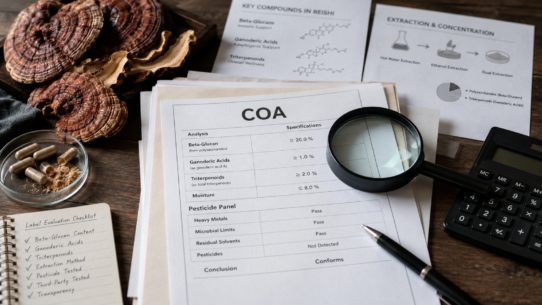
Spend any time looking at certificates of analysis for mushroom products and you will see numbers like 30% polysaccharides, 25% beta-glucans, 4% triterpenes, 0.3% ganoderic acids, 7% cordycepin. These numbers feel reassuring. They look like science.
They are useful, but they are not always what they appear to be, and the issue is rarely a lab-cost question. It is a question of interpretation, and of where loopholes open up between method and material.
Polysaccharides and beta-glucans are not the same thing. The most common polysaccharide test, the phenol-sulfuric acid method, measures total carbohydrates. If a mushroom extract has been dried with maltodextrin, the maltodextrin will register in the polysaccharide number. A “50% polysaccharide” Reishi extract may contain very little Reishi-specific beta-glucan. The Megazyme mushroom and yeast beta-glucan assay is often used because it can better distinguish beta-glucans from starches, added sugars, and many carrier polysaccharides than older total polysaccharide methods.
Carriers and added fibers complicate even the more specific tests. Polydextrose and other added dietary fibers can show up in ways that affect how certain beta-glucan and fiber-related results are read. Without knowing what carriers were used and at what level, a single number on a certificate can be hard to interpret accurately.
A natural beta-glucan reading does not automatically mean a useful product. Fruiting body fine powder and mycelium powder both contain beta-glucans as part of their cell walls. They can test positive for beta-glucan in a meaningful percentage. But “contains beta-glucan” is not the same as “extracted,” “soluble,” “digestible,” or “equally bioavailable.” A finely milled raw powder and a properly extracted concentrate can produce comparable beta-glucan numbers on a sheet of paper while behaving very differently in the body.
The same kind of issue affects Reishi triterpenes. A UV total triterpene test reads a broad range of compounds and tends to produce a higher number. An HPLC ganoderic acid test measures specific compounds and produces a lower number. Both are legitimate methods; they measure different things. A 4% UV total triterpene Reishi and a 4% HPLC ganoderic acid Reishi are not the same product, even when the percentage looks identical.
Natural materials vary. A wild mushroom and a cultivated mushroom are different. A spring harvest and an autumn harvest are different. Reishi grown on suitable hardwood logs or hardwood sawdust — typically from non-resinous broadleaf trees, woods that do not carry the oils or resins that would inhibit mycelial growth — varies with the specific wood, the strain, the climate, and the cycle. Strain matters. Drying conditions matter. Storage matters. A specification number for a mushroom extract should usually be understood as a reference range that the producer commits to meeting, not as a fixed chemical truth.
This does not make standards useless. They are necessary. They protect buyers from outright fraud and create a common language for trade. But they should be read with awareness of how they were measured, what carriers and processes might be sitting behind them, and what the number can and cannot tell you.
The human side of the supply chain
Mushroom product quality is shaped not only by raw materials and technology, but also by people. This is the part most marketing material avoids, because it is harder to put on a webpage than a clean lab number.
A typical Western brand or contract manufacturer is several layers away from the actual mushroom. They place an order with a supplier. The supplier may or may not be the manufacturer. They may also be a trading company, a middleman, or a relabeler buying from multiple sources and blending the result. The buyer often does not know which of these they are dealing with. Sometimes a “manufacturer” turns out to be a sales office. Sometimes a “factory tour” is of a factory the seller does not actually own.
The opacity does not stop with consumers. By the time a material has left the original extract factory and passed through middlemen, repackers, contract manufacturers, brands, and retailers, the real composition may no longer be transparent to anyone in the chain. Trading companies may not know the production details. Contract manufacturers may rely on supplier documents they cannot independently verify. Brands may only see a certificate of analysis and a contaminant panel. Distributors and retailers tend to repeat the brand’s claims. Consumers see only the final label. In some cases, the only people who actually know what is in the powder are the people who originally manufactured the extract — and they are several handshakes away from anyone reading the label.
On top of this, most safety testing in the Western supply chain focuses on contaminants. Pesticides, heavy metals, polycyclic aromatic hydrocarbons (PAH), ethylene oxide (ETO) residues, microbiology — these are necessary tests, and they prevent real harm. But they are designed to answer a specific question: is this material safe to consume at this dose? They are not designed to answer questions about identity, purity, or the real presence of functional compounds, and they are sometimes treated as if they were.
A clean pesticide and heavy metal report does not prove:
- that the material is what the label says it is
- that no carriers or fillers have been added
- that the active compounds described in the research are actually present at meaningful levels
- that the extraction method matches what the brand has claimed
There is also a quieter issue. Adulteration with carriers can make safety testing look better than it should. A material that is heavily cut with maltodextrin, polydextrose, or other excipients will show lower contaminant levels per gram simply because much of what is being tested is no longer the mushroom — it is the diluent. A poorly sourced raw material, blended down with cheap carrier, can pass a contaminant panel that the undiluted material would have failed. Identity and purity testing — methods that confirm the material actually is what it claims to be, in the proportion claimed — are a different category of testing, and they are far less common in this industry than they should be.
None of this means the industry is broken. There are excellent manufacturers, careful brands, and serious supply-chain professionals doing the work properly. It does mean that the human layer — who you are buying from, what they actually do, what they actually test for, and what they choose not to test for — is part of product quality, not separate from it.
Evidence helps us think, but it does not remove individual difference
A lot of mushroom marketing leans on research. “Studies show.” “Clinically proven.” “Backed by science.” These phrases sound strong, but they need to be read carefully.
Different types of evidence carry different weight.
Traditional use is real evidence in the sense that mushrooms have been observed and used by people across many generations. It is not nothing. But traditional use does not specify dose, preparation, or which compounds matter. A Reishi decoction simmered for hours in a clay pot is not the same as a 500 mg capsule of spray-dried extract.
Cell studies show what happens when mushroom compounds meet living cells in a controlled environment. They are useful for understanding mechanism. They cannot tell you what happens when a person swallows a capsule, digests it, absorbs whatever fraction reaches the bloodstream, and then experiences whatever downstream effects follow.
Animal studies show effects in living systems. They are stronger than cell studies but still indirect. Doses that work in mice do not translate cleanly to humans. The form of the mushroom used in the study often does not match what is sold in stores.
Human studies are more relevant, but they still need to be read carefully. What product was used? What dose? For how long? In what population? What was actually measured? A study using a specific extract at a specific dose is evidence about that extract at that dose. It is not automatic evidence about every product carrying the same mushroom name.
Even strong human studies describe averages across a sample. They do not predict any individual person’s response. Two people taking the same Reishi extract at the same dose for the same length of time can have noticeably different experiences. Genetics, gut microbiome, baseline health, diet, sleep, stress, and many other variables shape how a mushroom product affects a particular person. Evidence is essential for thinking clearly. It is not a guarantee of personal outcome.
The final purpose is human use
It is easy in this industry to lose sight of why any of this exists.
A mushroom product is not made so it can sit on a certificate of analysis. It is made so a person can take it. The point is not a number on a spec sheet, however clean and high it looks. The point is whether the person who swallows the capsule, drinks the tincture, or stirs the powder into their coffee actually receives the mushroom in a useful form.
That is a different question from whether the COA passes. It includes:
- Bioavailability — is the active material in a form the body can actually absorb?
- Suitability — does this format match this person, this purpose, this lifestyle?
- Dose — is the active fraction present at a meaningful level, taken at a meaningful frequency?
- Consistency — does batch-to-batch quality hold up over time, not just on the launch sample?
- Real-world response — does it actually do something useful for the person taking it, observed honestly over weeks rather than imagined from one capsule?
A product can pass every standard test and still not serve the person taking it. A product can have a less impressive certificate and still be the more honest, more usable choice. Specifications are a means; the human outcome is the goal. A site about mushroom products that forgets this becomes another spec-sheet shop. The harder, more useful work is keeping the human end of the chain in view at every step.
Why I built Yi Loves Mushroom — and how it will help you choose
I have spent many years in this industry, across raw material, cultivation, extraction, testing, supply, and finished product development. I will spare you the résumé. What matters more is what those years let me actually see.
I have watched good brands — people who genuinely care about mushrooms and about the people taking them — struggle to find suppliers they could trust. I have sat with brand owners who felt helpless because there was no realistic way for them to independently verify what their supplier was telling them, especially after the contracts were signed and the orders were already moving. I have seen suppliers mislead, omit, or quietly redefine what was in a product, sometimes because they had been misled themselves further upstream. I have seen consumers walk into stores fluent in beta-glucans and triterpenes and still be unable to tell whether the product in their hand was honest. And I have seen things I would rather not have seen — adulteration that was clearly deliberate, certificates of analysis that did not match the material in the drum, factory presentations staged for export buyers.
The point of saying this is not to be cynical. The people in this chain are mostly trying to do good work. Farmers cultivating Reishi on suitable hardwood logs and sawdust beds, or Cordyceps militaris in clean rooms. Extraction technicians running hot water vats, alcohol systems, and concentration lines. Lab analysts running HPLC, beta-glucan assays, microbiology tests, and contaminant panels. Brand owners trying to build something they can be proud of. Practitioners recommending mushrooms to clients who genuinely benefit. Most of the work, most of the time, is serious. The problem is that the working knowledge that experienced industry people carry in their heads tends to stay in their heads, while the public conversation about mushrooms is increasingly led by marketing.
This site is built to bring some of that working knowledge into the open in a usable form. It is structured around a simple, practical framework you can apply to almost any mushroom product:
- Raw material — what is the form, source, strain, and substrate, and does that match the claim?
- Processing and extraction — what was actually done to the material, with what method, and for what purpose?
- Drying and carriers — what was added, why, and at what level, and how does that affect how the spec sheet reads?
- Testing — which compounds, by which method, with what limitations, and what cannot be inferred from the number?
- Research connection — does the finished product actually reflect the studies it is being sold against?
- Supply chain — who made it, who sold it, and what kind of testing did and did not happen along the way?
- Human fit — is this format, dose, and quality genuinely suitable for the person and the purpose?
The articles on this site will go through these questions in detail, mushroom by mushroom and topic by topic. How Reishi is actually grown in China. The difference between fruiting body, mycelium, spore powder, and spore oil. Why hot water extraction is used and where alcohol or enzyme-assisted steps add or distort something. How beta-glucan testing actually works and why two labs can produce different numbers from the same sample. What the Lion’s Mane research really says and what it does not say. Where the supply chain has weak points and how to spot them.
I am not here to tell you which brand to buy, attack any part of the industry, or claim that mushrooms cure anything. I am here to share what I have learned so that consumers, practitioners, formulators, and brand owners can ask better questions, recognise more honest answers, and make choices that hold up over time.
The right product, not the best product
There is no single best mushroom product. There are products that suit a particular purpose, a particular person, and a particular standard of honesty — and products that do not. Once you have a framework for telling them apart, the noise in the market becomes a lot easier to navigate.
The mushroom industry will keep growing. New brands will appear. New formats will arrive. New research will be published. The basic question for any consumer or practitioner stays the same: not “is this mushroom good,” but “is this product, the actual product in front of me, the right one for my purpose?”
This website is not here to tell people that mushrooms are magical. It is here to give them the working tools — raw material, processing, drying, testing, research connection, supply chain, human fit — to look at any mushroom product and judge whether it is suitable, honest, and meaningful for the person who will actually take it.
This article is for educational purposes only. It is not medical advice and does not claim that mushroom products diagnose, treat, cure, or prevent disease.
Discover more from Yi Loves Mushrooms
Subscribe to get the latest posts sent to your email.