Why beta-glucans, ganoderic acids, triterpenoid compounds, and pesticide reports all need technical interpretation
A Reishi label can be full of numbers and still not tell us how the product was really made, what the numbers mean together, or whether the product is suitable for its intended use.
This article walks through two anonymised real-world examples — Product A and Product B — to show how the arithmetic works on a Reishi label, and where the interpretation gets harder than the numbers make it look. Neither example is being singled out as fraudulent or unsafe. Both products present themselves with more technical information than the average Reishi supplement, and both publish documentation that more cautious brands do not. The point of looking at them is not to attack anyone. The point is that even professional-looking Reishi labels and certificates of analysis can leave important technical questions unanswered, and that those questions are worth knowing how to ask.
I also do not assume that the brand owners necessarily understand all of these technical details themselves. In many cases they are relying on what their ingredient supplier or contract manufacturer has told them. The details that matter most for label interpretation — formulation structure, extraction logic, carrier use, the specific testing method behind each number, and what each measurement can and cannot rule out — are exactly the details that an upstream supplier should be expected to disclose clearly. When that disclosure is missing or unclear, brand owners are working with limited information too. A lot of what looks like a brand-level question on a label is, underneath, a supplier-disclosure question.
The numbers below come from publicly available labels and third-party reports. The discussion is built on the arithmetic those numbers force, plus the kind of judgment that comes from working in the mushroom extract industry for many years.
Product A: high UPLC Reishi triterpenoid markers alongside high Megazyme beta-glucan
The first example is a Reishi capsule product with two third-party certificates of analysis on the same batch.
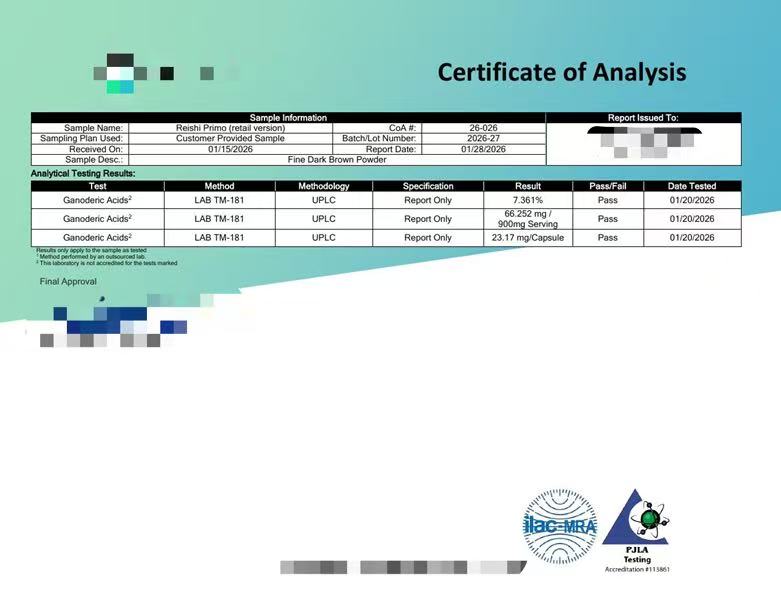
One COA reports specific Reishi triterpenoid markers — ganoderic acids together with ganoderenic acids — quantified by UPLC as reported by the laboratory. Per 900 mg serving, the total of these identified Reishi triterpenoid markers is 66.252 mg, which works out to 7.361% of the serving. Per single capsule (approximately 314.75 mg of finished powder, on the lab’s own working basis), the figure is 23.17 mg, which checks back to the same 7.361%.
The other COA, from a different third-party lab, reports beta-glucan by the Megazyme mushroom and yeast assay (kit K-YBGL). Per 900 mg serving, beta-glucan is 0.288 g — 288 mg, or 32.0% of the serving.
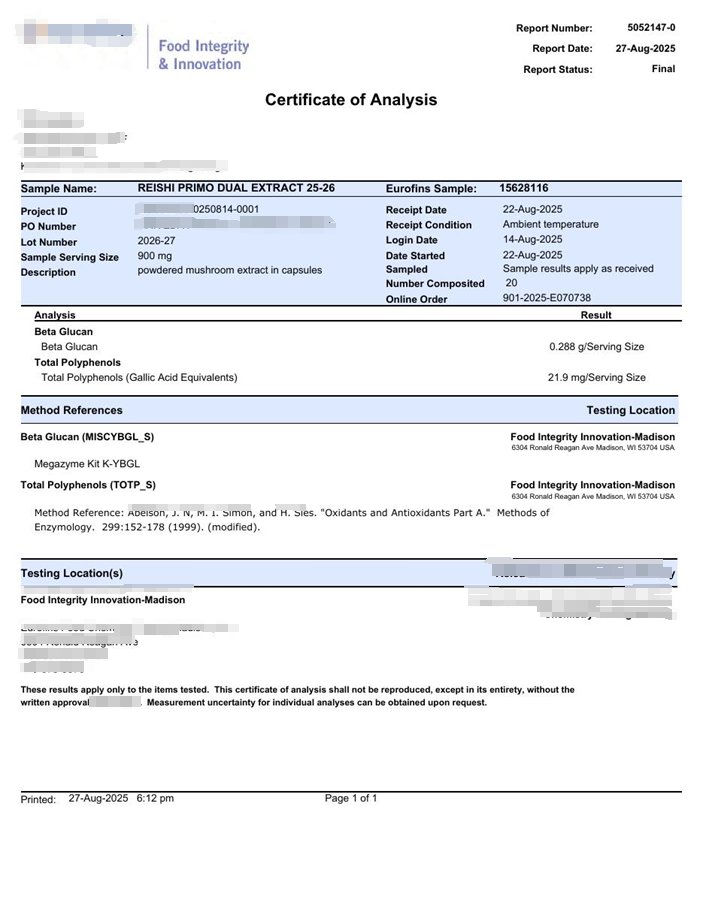
Table 1. Product A calculation summary.
| Item | Reported value | Calculation | Result | Why it matters |
|---|---|---|---|---|
| Ganoderic and ganoderenic acids per serving | 66.252 mg per 900 mg serving | 66.252 ÷ 900 | 7.361% | Quantified by UPLC against specific Reishi triterpenoid markers; more specific than UV-style total triterpenoid testing. |
| Ganoderic and ganoderenic acids per capsule | 23.17 mg per capsule (~314.75 mg finished powder) | 23.17 ÷ 314.75 | 7.361% | Cross-check that the per-capsule and per-serving figures agree on the same finished material. |
| Beta-glucan per serving | 0.288 g (288 mg) per 900 mg serving | 0.288 ÷ 0.900 | 32.0% | Megazyme K-YBGL assay; more specific than phenol-sulfuric acid total polysaccharide. |
| Headline combination | Both methods on the same finished material | See above | ~7.36% combined ganoderic/ganoderenic + ~32% beta-glucan | Hitting both numbers in one material is mechanically difficult for a single extraction step; see manufacturing analysis below. |
So on paper, Product A is a Reishi material that runs at roughly 7.36% combined UPLC ganoderic and ganoderenic acids and 32% Megazyme beta-glucan in the same finished powder.
The methods named are serious methods, but serious-looking methods still need context: method details, accreditation scope, sample preparation, and whether the same lot was tested across different reports all matter. In isolation, both numbers look serious. The harder question is whether they make manufacturing sense together.
Here is where the manufacturing question starts.
In my manufacturing experience, a single Reishi material that reads both at ≥7% combined UPLC ganoderic and ganoderenic acids and at >30% Megazyme beta-glucan is unlikely to be a simple alcohol extract alone. Ganoderic acids and ganoderenic acids are relatively less polar Reishi triterpenoid compounds; in extract production, they are commonly enriched through ethanol or other organic-solvent extraction systems [1,2]. Mushroom beta-glucans are structural cell-wall polysaccharides; in extract production, beta-glucan-rich fractions are usually associated with hot-water extraction, and beta-glucan also exists naturally in fruiting body fine powder and mycelium powder as cell-wall material [3-5].
A pure alcohol extract typically does not deliver a 30%+ Megazyme beta-glucan reading on its own. A pure hot-water extract typically does not deliver a 7%+ UPLC ganoderic acid reading on its own. Hitting both numbers in a single finished powder usually requires either deliberate dual extraction with reblending of fractions, or admixture of separately prepared components into one material.
To put numbers on those production limits — and these are manufacturing-experience benchmarks, not literature-proven universal laws — a concentrated Reishi fruiting body alcohol extract made without extreme purification or unusual intervention typically reaches around 9–10% combined ganoderic and ganoderenic acids by HPLC/UPLC, and rarely exceeds 12%. The high-strength ethanol that gets you into that range is in practice 70% to about 90% (90% is close to the highest concentration commonly accepted under factory safety control; 70% is more common). The same high-strength alcohol extract normally does not carry high beta-glucan. In my experience, beta-glucan in a pure alcohol extract is usually low — often below 5% — because the process is not designed to recover the water-soluble or structural polysaccharide fraction. A clean Reishi hot-water extract without carriers, by contrast, may run in the region of 20–25% Megazyme beta-glucan. If Reishi fruiting body fine powder is added back into a water extract, total Megazyme beta-glucan can move toward or above 30%, although much of the beta-glucan contributed by the fine powder sits as insoluble cell-wall material rather than as extracted soluble polysaccharide.
These ranges are what I have seen repeatedly at factory scale in ordinary industrial extraction. Other production approaches can move them around; rare combinations of raw material and processing exist. The point is the typical envelope, and what happens when two values from inside that envelope are stacked into a single finished material.
These figures are not proposed as global limits for all possible purified Reishi fractions. They are factory-scale benchmarks for ordinary industrial extraction without extreme purification, isolated-fraction processing, or addition of marker compounds. Highly purified or isolated material can sit outside this envelope by design; the question for a finished retail product is whether the route into that envelope has been disclosed.
Now apply that to Product A. A 9–10% triterpenoid alcohol extract blended with a 20–30% beta-glucan water-extract or fine-powder fraction would, on a simple mass-balance basis, ordinarily dilute the triterpenoid marker number below the level either component carried on its own. It is mechanically difficult to keep the final material at roughly 7% combined ganoderic and ganoderenic acids and simultaneously push beta-glucan above 30%, unless the beta-glucan side of the blend is coming from a component with a very high apparent glucan number. A soluble glucose-based polymer such as polydextrose is one material that, depending on how it behaves in the Megazyme assay, could raise the calculated beta-glucan figure without diluting the triterpenoid marker as much as a normal Reishi water extract or fine-powder fraction would. That is one possible explanation among several. None of them can be confirmed or excluded from the label and the two COAs alone.
From my manufacturing experience, the candidates I would want ruled out for a material with this label profile include: an alcohol extract combined with Reishi fruiting body fine powder; an alcohol extract combined with a separately produced water-extracted fraction; an alcohol extract combined with a soluble glucose-based polymer such as polydextrose; or some combination of the above. Each of these would help reconcile the high combined ganoderic/ganoderenic acid figure and the high Megazyme beta-glucan figure in a single material. None of them is the same product as a clearly disclosed dual extract made from declared water- and alcohol-extracted fractions of Reishi fruiting body.
Without formulation disclosure, taste evaluation, or independent identity testing, I cannot prove whether the beta-glucan contribution in Product A comes from Reishi fine powder, a water-extracted fraction, polydextrose, or another glucose-based material. From a manufacturing standpoint, however, the combination is too strong to treat as a simple single extract. The label numbers strongly suggest the material structure is more complex than a single-extract narrative implies, and the numbers justify the question.
Product A — open technical questions
| The combination of ~7.36% UPLC Reishi triterpenoid markers (combined ganoderic and ganoderenic acids) and 32% Megazyme beta-glucan is difficult to explain as a simple single extract. Possible explanations that should be ruled out by formulation disclosure or independent identity testing include Reishi fruiting body fine powder, a separately produced water-extracted fraction, polydextrose, or another glucose-based material. The pesticide panel attached to the published documentation is narrower than a broad multi-residue screen. For a high-strength alcohol Reishi extract, pesticide, PAH, and lipophilic contaminant risk requires broader finished-extract testing than a narrow legacy panel can deliver. This is not an accusation against the brand. It is a supplier-disclosure and finished-material verification question. |
|---|
Product B: a label with high beta-glucan, high alpha-glucan, high total triterpenoid compounds, and almost no specific Reishi ganoderic acids
The second example is a different Reishi capsule product. Its public label declares, per two capsules, "920 mg of organic fruiting body extract of Ganoderma lucidum" at a stated 71.76%, plus a vegetable capsule shell and an acerola extract.
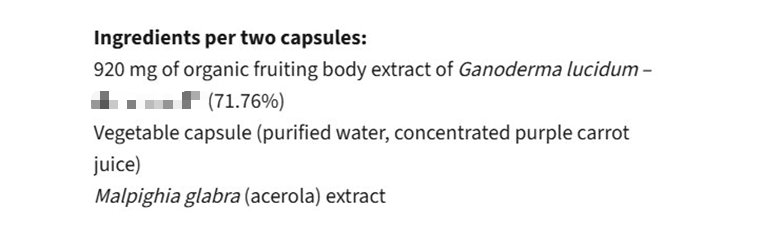
The label can be read in more than one way, and the difference matters for the arithmetic. One reasonable reading is that the 71.76% refers to the Reishi extract portion within the listed 920 mg ingredient amount, in which case the Reishi extract portion per two capsules is 920 mg × 71.76% = 660.192 mg and the remainder of the ingredient mass is the non-Reishi portion (capsule material and acerola extract). A more conservative reading is to treat the full 920 mg per two capsules as the Reishi extract amount and disregard the percentage qualifier. Both readings are worth doing because they bracket the calculation.
Table 2. Product B calculation table (660.192 mg denominator: 71.76% reading).
| Item | Reported amount per two capsules | Calculation | Result | Interpretation |
|---|---|---|---|---|
| Reishi extract portion (basis) | 920 mg × 71.76% | 920 × 0.7176 | 660.192 mg | Reference base for the percentages below; non-Reishi mass (capsule, acerola) sits outside this base. |
| Beta-glucans | 248 mg | 248 ÷ 660.192 | 37.56% | High; raises the question of source (extracted soluble fraction, fine powder, or glucose-based polymer behaving as glucan in the assay). |
| Alpha-glucans | 129 mg | 129 ÷ 660.192 | 19.54% | High for Reishi fruiting body extract; resembles patterns seen with resistant-dextrin-type / glucose-polymer materials. |
| Total triterpenoid compounds | 50 mg | 50 ÷ 660.192 | 7.57% | Broad colorimetric-style number; not specific for Reishi triterpenoids. |
| Ganoderic Acid A, F, C2, D (combined) | 4.43 μg (0.00443 mg) | 0.00443 ÷ 660.192 | 0.000671% | Specific HPLC/UPLC quantification of named Reishi compounds; ≈ 11,000× lower than the broad triterpenoid number on the same product. |
| Ergosterol | 385 μg (0.385 mg) | 0.385 ÷ 660.192 | 0.058% | Reference sterol; supports identity expectation for Reishi material. |
Table 3. Product B conservative calculation (920 mg denominator).
| Item | Reported amount per two capsules | Calculation | Result | Interpretation |
|---|---|---|---|---|
| Reference base (conservative) | 920 mg (full ingredient mass) | 920 mg | 100% | Treat the full 920 mg as the Reishi extract amount, disregarding the 71.76% qualifier; gives the lower-bound percentages. |
| Beta-glucans | 248 mg | 248 ÷ 920 | 26.96% | Still high; same source-of-glucan question as the 660 mg reading. |
| Alpha-glucans | 129 mg | 129 ÷ 920 | 14.02% | Still in the 10–20% range that resembles glucose-polymer patterns more than clean fruiting body extract. |
| Total triterpenoid compounds | 50 mg | 50 ÷ 920 | 5.43% | Broad number still much higher than specific ganoderic acid measurement on the same product. |
| Ganoderic Acid A, F, C2, D (combined) | 4.43 μg (0.00443 mg) | 0.00443 ÷ 920 | 0.000482% | Eleven-thousand-to-one ratio against the broad triterpenoid number holds under this denominator too. |
| Ergosterol | 385 μg (0.385 mg) | 0.385 ÷ 920 | 0.042% | Reference sterol value, conservative denominator. |
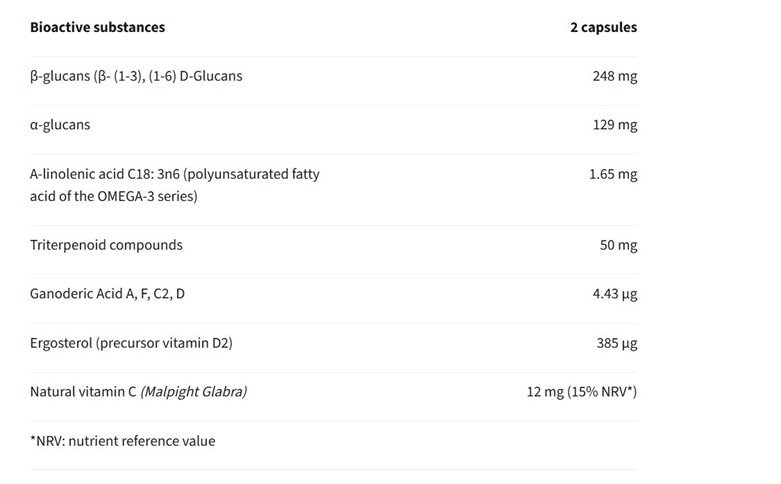
The label also lists only 1.65 mg of an omega-3-series fatty acid per two capsules. Using the 660.192 mg denominator, this is about 0.25%; using 920 mg, it is about 0.18%. This does not prove the absence of an alcohol-extracted fraction, but it does not look like a product carrying a substantial lipid-rich Reishi fraction. That makes the simultaneously reported high "triterpenoid compounds" figure more difficult to explain, not easier. Natural vitamin C is listed separately from the Reishi extract, sourced from the acerola ingredient.
The headline numbers — 37.56% beta-glucan and 7.57% total triterpenoid compounds on the higher-denominator reading, or 26.96% and 5.43% on the more conservative one — look strong under either denominator. The full panel actually contains more identified compounds than most Reishi labels do, which is in itself unusual and on the surface looks like a transparency win.
The central technical issue is the gap inside that panel, and it holds under either reading of the denominator.
Under the 660.192 mg reading, total triterpenoid compounds run at about 7.57% while specified Reishi ganoderic acids run at about 0.000671% — a ratio of roughly eleven thousand to one. Under the more conservative 920 mg reading, the same comparison is 5.43% against 0.000482% — a ratio of roughly eleven thousand to one. The denominator argument does not move the underlying problem. The broad triterpenoid number is approximately four orders of magnitude larger than the specific Reishi ganoderic acids number on the same product, and that is the question the rest of this case has to confront.
In my production experience, even a Reishi material showing around 4% total triterpenoids by a UV/colorimetric method using oleanolic acid as the reference standard would normally be expected to contain a measurable level of specific Reishi ganoderic acids. In some batches, Ganoderic Acid A alone may reach around 0.2–0.4%. A product showing 5–7% "triterpenoid compounds" but only 0.00048–0.00067% combined Ganoderic Acid A, F, C2 and D is therefore a serious technical mismatch — not a small calibration difference between methods, but a gap of several orders of magnitude on what should be related measurements.
From a production and testing standpoint, my first suspicion would be that the broad "triterpenoid compounds" value is being driven by an oleanolic-acid-type or other non-Ganoderma triterpenoid contribution, rather than by true Reishi-specific ganoderic acids. This does not prove that oleanolic acid was added to Product B, and it is not a claim about any specific compound being present. It is exactly the kind of possibility that should be ruled out by method disclosure and by HPLC/UPLC verification of the broad number on the same lot.
A second open question is the alpha-glucan figure — 19.54% under the higher-denominator reading, or 14.02% under the conservative denominator. In my manufacturing experience, alpha-glucan at that level is high for what is sold as a Reishi fruiting body extract. Reishi fruiting body is not normally a high-alpha-glucan material. The combination of a high calculated beta-glucan with an alpha-glucan in the 10–20% range is closer to the pattern I have seen with resistant-dextrin-type or other glucose-polymer materials than with a clean Reishi fruiting body extract. Some resistant-dextrin or glucose-polymer materials can show 10–20% alpha-glucan while also producing high calculated beta-glucan values — sometimes well above 50%, depending on the assay and the structure of the polymer. This does not prove that such a material is present in Product B. It is exactly the kind of pattern that should be ruled out by identity testing or formulation disclosure, and the label alone does not do that.
The distinction between maltodextrin, polydextrose, and resistant dextrin matters here. Maltodextrin would normally be expected to increase alpha-glucan more than beta-glucan, because maltodextrin is largely composed of α-1,4 glucose linkages and behaves more like a digestible starch fragment in the assay. Polydextrose, depending on assay behaviour, may mainly affect the calculated beta-glucan side rather than the alpha-glucan side. A resistant-dextrin-type glucose polymer can produce a pattern where alpha-glucan sits in the 10–20% range while calculated beta-glucan remains high. That last pattern is much closer to Product B’s label profile than a clean Reishi fruiting body extract would be. None of this proves which material, if any, is present. It is the kind of pattern that should be ruled out through formulation disclosure and identity testing.
Product B — open technical questions
| The high beta-glucan figure combined with an alpha-glucan in the 10–20% range resembles resistant-dextrin-type or glucose-polymer materials more closely than a clean Reishi fruiting body extract. Maltodextrin would be expected to increase alpha-glucan more than calculated beta-glucan in this assay; it does not, on its own, account for Product B’s label profile. Polydextrose, depending on assay behaviour, may mainly affect the calculated beta-glucan side rather than the alpha-glucan side. Resistant dextrin is especially relevant because it can produce both a 10–20% alpha-glucan signal and a high calculated beta-glucan value simultaneously. The "total triterpenoid compounds" value (5.43–7.57%) and the four specific HPLC ganoderic acids combined (0.00048–0.00067%) are severely mismatched on the same product — roughly four orders of magnitude apart. The omega-3-series fatty acid declaration (0.18–0.25%) does not support the presence of a substantial lipid-rich Reishi fraction, which would normally be expected if the high "triterpenoid" number were Reishi-specific. Method disclosure for the broad triterpenoid figure, HPLC/UPLC verification on the same lot, and identity testing of the source material are what would close these questions. |
|---|
Why ganoderic acids and beta-glucan-rich material do not usually come from the same extraction step
Both cases circle back to the same point of chemistry and production logic. It is worth spelling out.
Ganoderic acids, ganoderenic acids and related Reishi triterpenoids are relatively less polar and more lipophilic compared to mushroom polysaccharides. They are commonly enriched through ethanol or other organic-solvent extraction systems, sometimes with subsequent precipitation or fractionation steps [1,2]. They are not normally the principal target of a simple hot-water extraction, although small amounts can come across.
Mushroom beta-glucans are structural polysaccharides in fungal cell walls. In extract production, they are commonly recovered through hot-water extraction, often in the soluble high-molecular-weight fraction [3-5]. They also remain present in raw fruiting body fine powder and in mycelium powder, where they sit as cell-wall material rather than as extracted soluble polysaccharide. An important corollary: a beta-glucan number on a sheet of paper does not automatically tell you whether the material is extracted, soluble, digestible, or equally bioavailable. Fruiting body fine powder, mycelium powder, water-extracted fractions, and dual extracts can all post beta-glucan numbers, and they are not the same product to the body.
The practical consequence: hitting both a high combined ganoderic and ganoderenic acid figure and a high Megazyme beta-glucan figure in one finished material almost always involves either dual extraction with deliberate reblending of fractions, or the addition of one or more separately prepared components. This is not a moral point about extraction; it is a fact about how extraction selects compounds with different polarities. The relevance to Product A is that its label numbers describe exactly that combination, which the buyer has a reasonable basis to ask about.
Megazyme beta-glucan: what it can and cannot rule out
The Megazyme yeast and mushroom beta-glucan assay (kit K-YBGL) is one of the more specific commercial methods for mushroom beta-glucan quantification. Compared with phenol-sulfuric acid total polysaccharide measurement, it is much better at separating mushroom beta-glucans from grain starches, added sugars, and many carrier polysaccharides. That is part of why it is named on more technically detailed Reishi COAs.
It is still worth understanding what it does and where it has limits.
The assay calculates beta-glucan by measuring total glucan and then subtracting measured alpha-glucan [6]. The result that gets printed as "beta-glucan" is the difference between those two steps. If a glucose-based polymer is present that contributes to total glucan but is not fully captured in the alpha-glucan step, that residual contribution will appear on the beta-glucan side of the subtraction.
This is not purely theoretical. Megazyme updated the yeast-and-mushroom beta-glucan method by adding trehalase to the alpha-glucan determination step, because trehalose in mushroom samples had been contributing to the total glucan reading in a way the assay had not previously accounted for [7]. Without trehalase in the alpha-glucan step, trehalose-rich material could push the calculated beta-glucan figure higher than it should be. After the method update, alpha-glucan readings rose and calculated beta-glucan readings fell for some mushroom materials. In my own experience, that pattern was visible in maitake, oyster mushroom, and shiitake samples I had tested under both procedures. The method change does not say anything about polydextrose or resistant dextrin specifically. It is a documented case of the assay being adjusted when an interfering carbohydrate was recognised, and it makes the general concern about glucose-based polymers something more than a thought experiment.
This is the basis of a real mechanism-based concern with certain glucose-based, digestion-resistant carbohydrates. Polydextrose and resistant dextrin are examples — they are glucose-based, branched, digestion-resistant polymers used widely as soluble fibres and as functional carriers [8-10]. Their behaviour in the Megazyme yeast-and-mushroom assay is something I would want to see ruled out, by identity testing or formulation disclosure, especially when a product simultaneously shows an unusually high alpha-glucan reading or other carbohydrate signals that are hard to attribute to clean fruiting body.
I am not claiming that any specific product on the market contains polydextrose or resistant dextrin. I am saying the question is technically reasonable, and that the way to close it is disclosure or identity testing, not silence.
There is also a much simpler limitation worth stating plainly. A Reishi material can contain real beta-glucan and still not be a usefully extracted product. Fruiting body fine powder, milled and capsuled, will show beta-glucan on Megazyme testing because the beta-glucan is sitting in the fungal cell wall. That does not mean it is solubilised, that it has been brought into a form that the body can actually receive, or that it behaves the same way in the gut as an extracted soluble fraction. The number on the COA is necessary information. It is not, on its own, the answer.
UV total triterpenoids vs HPLC/UPLC ganoderic acids: not the same number
Reishi triterpenoid quantification is one of the longest-running interpretation problems in the supplement industry, and Product B’s label is a good place to look at it carefully.
Broadly speaking, there are two families of methods on the market.
UV or colorimetric "total triterpenoid" methods read absorbance after a colour reaction with a reagent system that responds to a broad family of triterpenoid-type compounds [11]. The result is typically reported as a percentage expressed against an external standard — historically oleanolic acid has been a common reference. These methods are inexpensive and they do detect Reishi triterpenoids, but they also respond to other triterpenoid-like compounds that may be present, and they do not distinguish among them. As a general rule, UV-style total triterpenoid numbers run higher than HPLC- or UPLC-based specific ganoderic acid numbers on the same material — sometimes substantially higher — because the broad method is reading a wider set of compounds.
HPLC and UPLC ganoderic acid methods, by contrast, identify and quantify specific Reishi compounds — Ganoderic Acid A, B, C2, D, F, and the corresponding ganoderenic acids, depending on the method. These methods are more expensive, slower, and require reliable reference standards, and the resulting numbers are typically lower. They are also far more meaningful for product judgment, because they tell you something specific about Reishi triterpenoid content rather than about a broader response that could include non-Reishi material.
Table 4. UV/colorimetric total triterpenoids vs HPLC/UPLC specific Reishi triterpenoid markers.
| Test type | What it measures | Typical limitation | Why it matters for Reishi |
|---|---|---|---|
| UV / colorimetric total triterpenoids | Absorbance after a colour reaction (e.g., vanillin–acetic acid plus perchloric acid at 546 nm) responding to a broad family of triterpenoid-type compounds. Typically expressed against an external reference (oleanolic acid or ursolic acid). | Not specific for Reishi. Responds to non-Ganoderma plant triterpenoids if present. Tends to read higher than specific HPLC/UPLC numbers — sometimes substantially higher — on the same material. | A high "total triterpenoid" number on a Reishi label does not, on its own, prove Reishi-specific triterpenoid content. The same colorimetric method can return high numbers on non-Reishi oils and other triterpenoid-containing matrices. |
| HPLC / UPLC specific Reishi triterpenoid markers | Identifies and quantifies named Reishi compounds (Ganoderic Acid A, B, C2, D, F and corresponding ganoderenic acids) against authenticated Reishi reference standards. | More expensive, slower, requires reliable reference standards; typically returns lower numbers because it counts only the named compounds. | More meaningful for Reishi product judgment because the number refers to specific Reishi compounds, not a broad chemical response. Comparable across products when methods and references are disclosed. |
| When a large gap exists on the same product | Broad UV number much higher than specific HPLC/UPLC number on the same finished material. | Suggests the broad number may be reading non-Ganoderma triterpenoid material or method-amplified response against the external standard. | Should be ruled out by method disclosure, HPLC/UPLC verification on the same lot, and ideally identity testing of the source material. |
Now apply this back to Product B. Total triterpenoid compounds: about 7.57% of the Reishi extract portion. Specified Reishi ganoderic acids (A, F, C2, D combined): about 0.000671% of the same Reishi extract portion. The broad number is about eleven thousand times larger than the specific number on the same product.
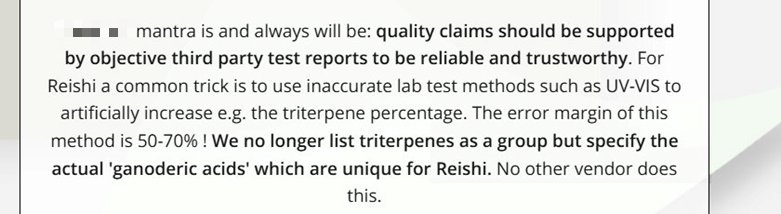
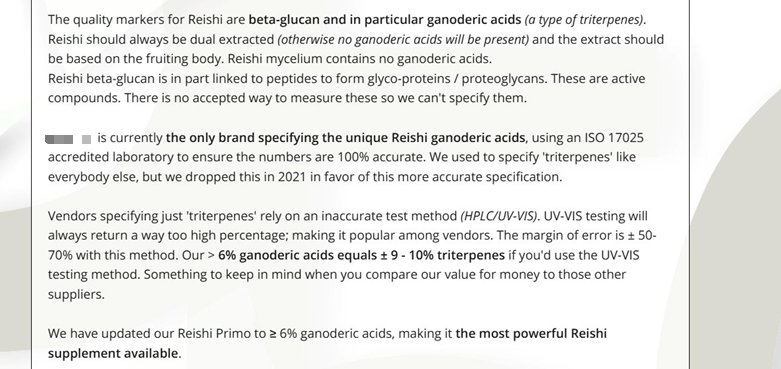
There is no simple technical reading that makes this gap disappear. In production terms, when a broad total triterpenoid figure runs this high while specific Reishi ganoderic and ganoderenic markers run this low on the same product, my working hypothesis — before any disclosure or independent testing — is that the broad value is being driven by triterpenoid-type compounds that are not Ganoderma-specific. Oleanolic acid is especially relevant here. It is widely used as the reference standard in Chinese-style UV/colorimetric "total triterpenoid" methods, it can come from non-Reishi plant sources, and any sample that reads against an oleanolic-acid calibration will respond to compounds in the broader triterpenoid family without distinguishing among them [11,12]. Other plant triterpenoids — ursolic acid and betulinic-acid–type compounds, for example — sit in the same general family without being Reishi-specific [12]. If any non-Ganoderma triterpenoid material were present in the formulation, or if the colorimetric method itself were producing a strongly inflated response against the external standard, the gap between the broad and specific numbers becomes easier to account for than if both were measuring the same thing.
From a production and testing standpoint, this is one of the first possibilities I would want ruled out — by method disclosure, by HPLC/UPLC verification of the broad number on the same lot, and ideally by identity testing of the source material. None of those is on the label. This is not a claim that any specific compound has been added to Product B. It is a statement about which question the label leaves open.
A useful warning from Reishi spore oil
The clearest published illustration of this exact problem comes from outside the capsule extract market entirely — from Reishi spore oil.
A 2024 review by Lin Zhibin — Research Progress on Therapeutic Material Basis of Ganoderma lucidum Spore Oil, published in Journal of Fungal Research (2024, 22(1):79–87, DOI 10.13341/jfr.2023.1679) — summarises the analytical evidence on Reishi spore oil quality testing [11]. The relevant points for this article are tightly focused on the gap between UV/spectrophotometric "total triterpenoid" results and specific HPLC results on the same Reishi material.
The UV/spectrophotometric method uses oleanolic acid or ursolic acid as the reference standard, with a vanillin–acetic acid plus perchloric acid colour reaction read at 546 nm [11]. It has been widely used to measure total triterpenoids and sterols in Reishi fruiting body and Reishi finished products. Multiple Reishi spore oil samples have returned high "total triterpenoid" values by this method — but so have several common edible oils tested alongside them. Reported figures from one published comparison cited in the review: Reishi spore oil 26.87%, peanut oil 27.76%, sunflower oil 33.64%, blended cooking oil 43.16%, corn oil 28.09%, soybean oil 39.14%. The cooking oils were not Reishi material. They were simply oils running through the same colorimetric method against the same plant-triterpenoid reference standard, and they came back at the same kind of number.
The review’s conclusion on the method is direct: a UV/spectrophotometric total triterpenoid method expressed against oleanolic or ursolic acid is not specific for Reishi triterpenoids, cannot exclude interference from other compounds, can seriously overestimate triterpenoid content, and is not suitable as a quality-control standard for Reishi spore oil and related products. HPLC measurements on the same kinds of Reishi material show triterpenoids at far lower levels: unbroken spore powder 14.24–99.70 μg/g, broken spore powder 20.43–99.70 μg/g, and spore oil samples below 50 μg/g across the cited studies — well under 0.01% in every case. The review concludes that triterpenoids are not suitable as quantitative quality-control markers for Reishi spore powder and Reishi spore oil.
This is not a Reishi spore oil article, and the spore oil category has its own separate problems that I would handle elsewhere. The reason for citing the spore oil literature here is narrower. It is the cleanest published demonstration that a "total triterpenoid" number, read by a colorimetric method against a plant-triterpenoid standard, is not the same number as specific Reishi ganoderic and ganoderenic acid content. A vegetable oil with no Reishi in it can post a similar number through the same method. That is the point that bears on Product B’s label, and it is bigger than any one product.
Reading the pesticide report
A pesticide report is not just pass/fail. The panel scope matters, the analytes included matter, and the reporting limits matter.
Product A in this case study has a publicly available third-party pesticide and metals report on the same batch as its potency COAs. That report uses a focused organochlorine and organophosphate panel — roughly a couple of dozen named analytes — alongside a heavy-metals panel. Several pesticide reporting limits sit at 0.01 mg/kg, which is fairly tight. Some others sit at 0.05, 0.1, or 0.2 mg/kg, which is much higher and means the report cannot speak to anything below those levels for those analytes. For metals, the report shows arsenic below the reporting limit, cadmium at the LOR, lead below the LOR, mercury well below the LOR, with chromium, copper, nickel, and zinc within ranges that are not unusual for organic fungal raw material.
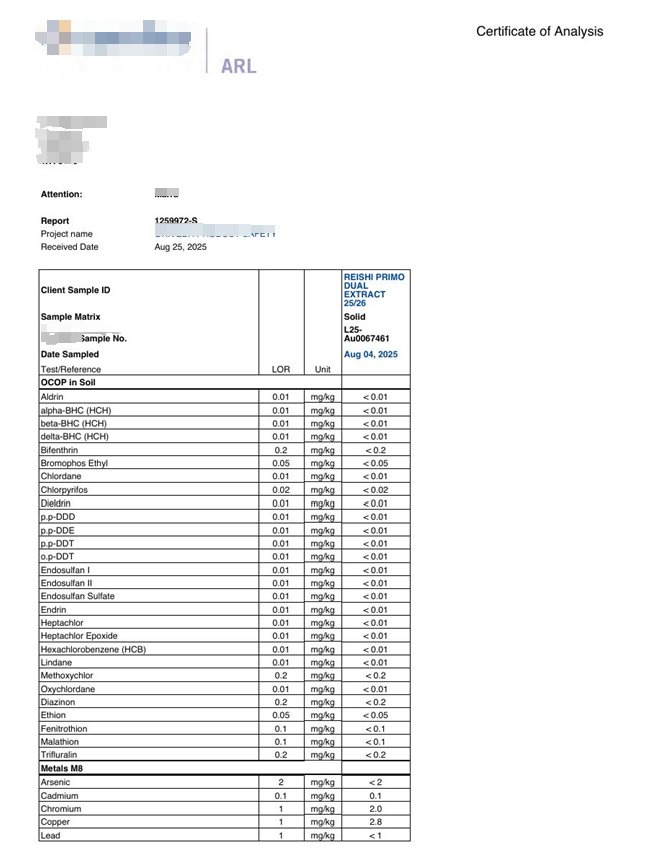
By comparison, a broad multi-residue pesticide screen — the kind run by international labs as a "general pesticide scan" — typically covers several hundred analytes by GC-MS/MS and LC-MS/MS, with the large majority of LOQs in the 0.01 mg/kg range [15-17]. Organic raw-Reishi powder reports have been seen to come back clean against 200, 300, even 500+ analyte panels at those LOQs. That is the comparison point.
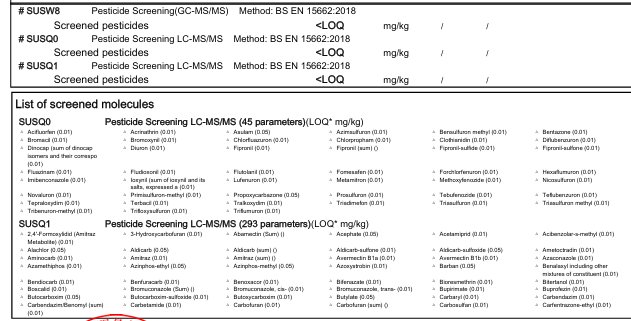
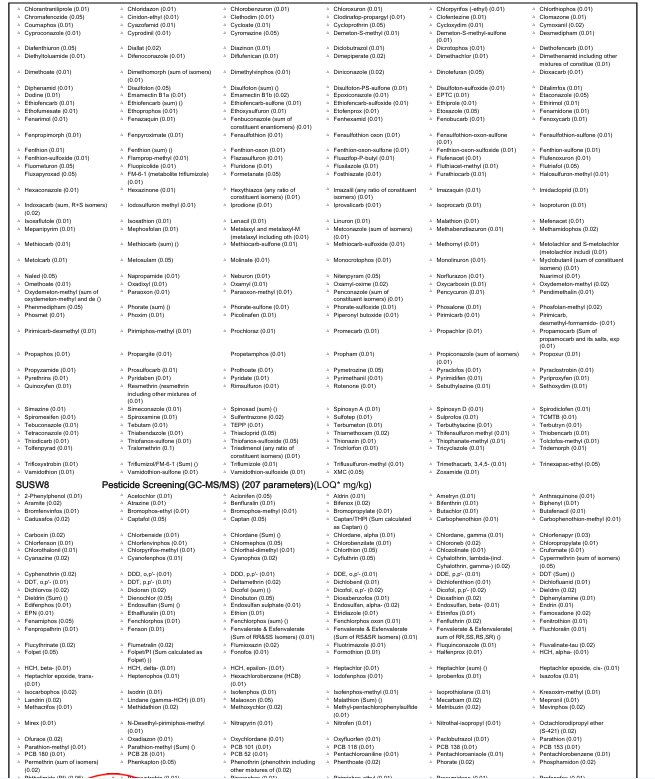
Table 5. Pesticide report interpretation.
| Report type | Panel scope | Typical strength | Limitation | Why it matters for concentrated alcohol extracts |
|---|---|---|---|---|
| Focused legacy panel (e.g., OC/OP only) | Roughly 20–40 analytes; predominantly organochlorine and organophosphate compounds plus selected related actives. | Captures most regulated legacy pesticides at fairly tight LORs for the included compounds. | Mixed reporting limits within the panel (some 0.01 mg/kg, some 0.05–0.2 mg/kg). Does not speak to most modern systemic insecticides, fungicides, herbicides, or neonicotinoid metabolites. | A clean result on a focused panel does not rule out residues outside the panel. Concentrated alcohol extracts can enrich lipophilic residues that a legacy panel was never designed to detect. |
| Broad multi-residue screen | Several hundred analytes (commonly 200–500+), run on GC-MS/MS and LC-MS/MS in parallel. | LOQs predominantly around 0.01 mg/kg per analyte; covers modern systemic insecticides, neonicotinoids, fungicides, herbicides, and many metabolites. | More expensive and slower. Still does not address identity, purity, formulation, or non-pesticide contaminants such as PAH or ETO/2-chloroethanol unless ordered separately. | A more demanding fit for concentrated alcohol Reishi extract, which is the matrix most likely to enrich lipophilic residues. Broader and tighter than a narrower legacy panel. |
| Organic certification | Production-system controls at cultivation and handling; permitted/prohibited inputs, traceability, audit. | Says something real about how the raw material was grown. | Not a finished-product pesticide test. Does not specify which pesticide panel was run on the finished concentrated extract or at what LOQ/LOR. | Complementary, not equivalent. A product with only an organic certificate and no broad finished-product screen has only answered half the residue question. |
The question for Product A is not whether the published report shows a pass. It does. The question is what the panel can rule out, and what it cannot. A narrower OC/OP-style panel does a serviceable job of catching the most regulated legacy pesticides. It does not speak to most modern systemic insecticides, most fungicides used in greenhouse and substrate-treatment contexts, herbicides, neonicotinoid metabolites, and the rest of the contemporary residue landscape. Some of the analytes that matter most for a concentrated alcohol-soluble extract are not in a basic OCOP panel.
This is not an accusation that the lab or the brand has done something wrong. A pesticide report exists in the form that was ordered and paid for. The interpretive question is whether the form ordered is adequate to the matrix. For a concentrated alcohol Reishi extract, a broad multi-residue screen at LOQs around 0.01 mg/kg is a more demanding test, and the difference matters.
Concentration risk: stronger extraction concentrates lipophilic compounds — and not only the ones you want
This is where production experience matters most for label reading.
When an extraction process is tuned to enrich less polar or lipophilic fractions — ethanol, dual extraction, supercritical CO₂ — it concentrates beneficial compounds in that polarity range. Ganoderic acids and related Reishi triterpenoids are precisely the kind of compounds those extractions are designed to recover.
The problem is that beneficial compounds are not the only molecules in that polarity range. Fat-soluble pesticides, polycyclic aromatic hydrocarbon residues, and other lipophilic organic contaminants can also be enriched if the raw material carries them. In my manufacturing experience, high-strength ethanol Reishi extracts with high ganoderic acid specifications are noticeably more likely to fail broad pesticide screens than raw Reishi powder or simple hot-water extracts on the same input material. I have seen this pattern repeatedly in production: a raw Reishi lot will pass a broad screen because residues are below the reporting limit, and then the same residues, concentrated into a high-strength alcohol extract, become detectable.
A clean raw-material pesticide test is therefore not, on its own, evidence that the concentrated extract from that raw material is also clean. The concentrated extract needs its own broad screen.
Different markets set different contaminant limits for finished extract products, which creates room for selective testing or market-specific routing decisions on the supplier side. The same matrix can pass in one jurisdiction and require more work in another. This is not unique to Reishi or to mushrooms — it is a feature of how concentrated natural-product extracts move through international supply chains — but it is part of why finished-extract panel scope and reporting limits matter as much as they do.
The parallel logic applies, with different mechanisms, to PAH residues and to ETO / 2-chloroethanol monitoring. These are not the same risks as pesticide residues, but the principle that concentrated extracts deserve broader and stricter safety thinking than raw powder is the same.
Organic certification and what it does not replace
Both of the products discussed here use organic positioning, and the label-reading lesson is the same in both cases.
Organic certification is a meaningful production-system designation. It covers permitted inputs at the cultivation stage, prohibited inputs, traceability, handling, and certifier audits. For Reishi and other cultivated mushrooms, an organic certificate from a credible scheme says something real about how the raw material was grown and what was and was not used on it.
What an organic certificate does not say is which pesticide panel was run on the finished extract, how many analytes were included, what LOQ was achieved for each, or whether the panel is appropriate to the matrix. Organic certification is primarily about the production system [13,14]. Broad multi-residue finished-product testing is about what is actually in the concentrated extract at the point of sale. These are different questions, and a strong answer to one is not a substitute for a strong answer to the other.
"Organic certification is meaningless" is the wrong reading. The right reading is that organic certification and broad finished-product pesticide screening at low LOQs are two complementary things, and a product that has only one of them has only answered half the question.
What this means when you read a Reishi label
The arithmetic on a Reishi label is doable. Most of what we did above was percentages and one division per row. The interpretation is harder.
A practical way to read a Reishi label and COA, drawn from the two cases above, is to ask the same handful of questions every time:
By what method? Phenol-sulfuric acid total polysaccharide and Megazyme beta-glucan are not the same test. UV total triterpenoid and HPLC/UPLC ganoderic acid are not the same test. The number alone is not enough — the method needs to be on the certificate, named clearly, and ideally tied to a specific lot.
Against what standard? UV-style methods are expressed against an external reference compound. The reference matters. A "7% triterpenoid" figure against oleanolic acid is not the same thing as a "7% ganoderic acid A" figure quantified against an authenticated Reishi reference.
As a percentage of what? Per serving, per capsule, per gram of finished powder, per gram of the Reishi extract portion of a multi-ingredient capsule — these are different denominators. Carrier-cut materials and capsules with non-Reishi co-ingredients require the reader to do the division carefully.
What else could explain this number? This is the question that the case studies in this article are really about. A high beta-glucan reading can come from extract, raw powder, or carrier behaviour in an assay. A high total triterpenoid reading can come from Reishi triterpenoids or from broader triterpenoid responses against an external standard. A clean pesticide pass can come from a broad screen at low LOQs or from a narrower panel with higher reporting limits.
Does the pesticide and contaminant testing match the matrix? Concentrated alcohol extract is a more demanding matrix than raw powder. The panel scope, the LOQs, and whether the test covers the analytes likely to enrich in this matrix all matter.
What is missing? Sometimes the most informative thing about a label is what it does not state. No method named. No lot tied to the COA. No identity testing. No carrier disclosure. No broad pesticide screen on the finished extract. Each missing item is its own open question.
None of this requires the reader to call any specific brand dishonest. Product A and Product B both provide more numbers than many Reishi capsules on the global market. That is exactly why they are useful teaching examples. Both publish lab reports. Both make specific claims that can at least be checked against arithmetic. The point of the exercise is that even at that level of transparency, the labels still leave gaps that the buyer can only close through disclosure and identity testing, not through label arithmetic alone.
A Reishi product, in the end, is not a label. It is a material made from a raw fungus, processed by specific decisions, dried under specific conditions, blended with specific other components, and tested by specific methods. The label is a summary of that history, and a partial one. Reading it well means reading what is on it, reading what is not on it, and knowing what questions to ask of the producer for the rest.
Technical Notes
Short reference points for the technical claims made above. These notes are supported by the references listed in the following section; a few author-experience benchmarks remain explicitly identified as manufacturing experience rather than literature-derived limits.
1. Reishi triterpenoid extraction polarity. Ganoderic acids and ganoderenic acids are Ganoderma lucidum triterpenoid markers. They are relatively less polar / more lipophilic than mushroom polysaccharides and are commonly enriched through ethanol or other organic-solvent extraction systems [1,2].
2. Mushroom beta-glucans and water extraction. Mushroom beta-glucans are fungal cell-wall polysaccharides. In extract production, water extraction is commonly used to recover soluble polysaccharide- and beta-glucan-rich fractions; raw fruiting body powder and mycelium powder also contain beta-glucan as cell-wall material that is not necessarily solubilised by milling alone [3-5].
3. Megazyme mushroom and yeast beta-glucan assay (K-YBGL). The assay calculates beta-glucan as the difference between measured total glucan and measured alpha-glucan on the same sample; Megazyme also documents the trehalase update to address trehalose-related overestimation in certain samples [6,7].
4. Polydextrose and resistant dextrin. These are glucose-based, digestion-resistant carbohydrates with branched / complex glycosidic linkages and are used as soluble dietary fibres or formulation aids [8-10]. Their behaviour in glucan- and fibre-related assays should be ruled out by identity testing or formulation disclosure when their presence is plausible. Note: a direct peer-reviewed K-YBGL-specific polydextrose interference paper has not yet been located.
5. UV/colorimetric vs HPLC/UPLC triterpenoid testing. UV/colorimetric "total triterpenoid" methods read absorbance after a colour reaction with a broad family of triterpenoid-type compounds, typically expressed against an external reference standard such as oleanolic acid or ursolic acid. HPLC/UPLC ganoderic acid methods identify and quantify specific Reishi compounds. These are different measurements; the numbers are not interchangeable [11].
6. Reishi spore oil UV-vs-HPLC evidence. Lin Z. Research Progress on Therapeutic Material Basis of Ganoderma lucidum Spore Oil. Journal of Fungal Research, 2024, 22(1):79–87. DOI: 10.13341/jfr.2023.1679 [11].
7. Organic certification scope. Organic certification schemes cover production-system controls — permitted and prohibited inputs, traceability, handling, and audit — at the cultivation and handling stages. They are not equivalent to broad multi-residue pesticide screening of the finished concentrated extract [13,14].
8. Pesticide panel scope and reporting limits. Multi-residue pesticide screens by GC-MS/MS and LC-MS/MS at low LOQs can cover hundreds of analytes; narrower legacy panels cover fewer analytes, sometimes at higher reporting limits. For concentrated alcohol-soluble extracts, broader screens at lower LOQs are more informative about residue risk [15-17].
Evidence limits to keep clear
The 9–10% / rarely above 12% combined ganoderic + ganoderenic acid benchmark, the <5% beta-glucan expectation for pure alcohol extract, and the 20–25% beta-glucan expectation for clean Reishi hot-water extract are retained as author manufacturing-experience benchmarks. They should not be converted into literature claims unless direct production-scale evidence is later added.
No direct peer-reviewed source has yet been located showing that polydextrose specifically returns an >80% beta-glucan value under Megazyme K-YBGL. The article therefore treats polydextrose and resistant dextrin as mechanism-based concerns that should be ruled out by disclosure or identity testing, not as proven findings for Product A or Product B.
References / Further reading
References and official source links for publication
The references below are intended to support the technical notes and method explanations in the article body. They should be retained in the published version as a "References / Further reading" block. The manufacturing-experience benchmarks in the Product A section remain author-experience data, not literature-derived universal limits.
[1] Galappaththi, M. C. A. et al. A Review of Ganoderma Triterpenoids and Their Bioactivities. Biomolecules / PMC record. URL: https://pmc.ncbi.nlm.nih.gov/articles/PMC9856212/
[2] Guo, W. L. et al. Ganoderic acids-rich ethanol extract from Ganoderma lucidum protects against alcoholic liver injury and modulates intestinal microbiota in mice with excessive alcohol intake. Current Research in Food Science, 2022. URL: https://pmc.ncbi.nlm.nih.gov/articles/PMC8913248/
[3] Ruiz-Herrera, J.; Ortiz-Castellanos, L. Cell wall glucans of fungi. A review. The Cell Surface 5:100022, 2019. DOI: 10.1016/j.tcsw.2019.100022. URL: https://pubmed.ncbi.nlm.nih.gov/32743138/
[4] Benito-Roman, O. et al. beta-Glucan recovery from Ganoderma lucidum by means of pressurized hot water and supercritical CO₂. Journal of Supercritical Fluids, 2016. URL: https://www.sciencedirect.com/science/article/abs/pii/S0960308515001467
[5] Zhong, Y. et al. A Review of Ganoderma lucidum Polysaccharide. Foods, 2024. URL: https://www.mdpi.com/2304-8158/13/17/2665
[6] Megazyme / Neogen. beta-Glucan Assay Kit (Yeast and Mushroom), K-YBGL assay protocol: total glucan minus alpha-glucan calculation and method limitations. URL: https://prod-docs.megazyme.com/documents/Assay_Protocol/K-YBGL_DATA.pdf
[7] Megazyme. Important update to the beta-Glucan Assay Kit (Yeast and Mushroom) (K-YBGL): trehalase addition and overestimation in trehalose-containing samples. URL: https://www.megazyme.com/news/important-update-to-the-beta-glucan-assay-kit-yeast-and-mushroom-k-ybgl
[8] U.S. FDA. Review of the Scientific Evidence on the Physiological Effects of Certain Non-Digestible Carbohydrates: polydextrose structure and linkages. URL: https://www.fda.gov/files/food/published/Review-of-the-Scientific-Evidence-on-the-Physiological-Effects-of-Certain-Non-Digestible-Carbohydrates-PDF.pdf
[9] U.S. eCFR. 21 CFR 172.841 — Polydextrose: permitted uses as bulking agent, formulation aid, humectant and texturizer. URL: https://www.ecfr.gov/current/title-21/chapter-I/subchapter-B/part-172/subpart-I/section-172.841
[10] do Carmo, M. M. R. et al. Polydextrose: Physiological Function, and Effects on Health. Nutrients, 2016. URL: https://pmc.ncbi.nlm.nih.gov/articles/PMC5037538/
[11] Lin, Z. Research Progress on Therapeutic Material Basis of Ganoderma lucidum Spore Oil. Journal of Fungal Research, 2024, 22(1):79–87. DOI: 10.13341/jfr.2023.1679.
[12] National Cancer Institute. Betulinic Acid definition; betulinic acid is a pentacyclic triterpenoid derived from birch bark. URL: https://www.cancer.gov/publications/dictionaries/cancer-drug/def/betulinic-acid
[13] Regulation (EU) 2018/848 on organic production and labelling of organic products. Official EUR-Lex text. URL: https://eur-lex.europa.eu/legal-content/EN/TXT/PDF/?uri=CELEX:32018R0848
[14] USDA National Organic Program. NOP 2611: Laboratory Selection Criteria for Pesticide Residue Testing. URL: https://www.ams.usda.gov/sites/default/files/media/2611.pdf
[15] USDA National Organic Program. NOP 2611-1: Prohibited Pesticides for NOP Residue Testing. URL: https://www.ams.usda.gov/sites/default/files/media/NOP-2611-1-ProhibitedPesticidesforNOPResidueTesting.pdf
[16] European Commission. Analytical quality control and method validation procedures for pesticide residues analysis in food and feed (SANTE 11312/2021). URL: https://food.ec.europa.eu/system/files/2023-11/pesticides_mrl_guidelines_wrkdoc_2021-11312.pdf
[17] European Commission. EU legislation on maximum residue levels (MRLs): default MRL of 0.01 mg/kg where not specifically mentioned; processing may require dilution/concentration adjustment. URL: https://food.ec.europa.eu/plants/pesticides/maximum-residue-levels/eu-legislation-mrls_en
Image note: All screenshots used in this article have been redacted to remove brand names, trademarks, product names, company names, lab names, report numbers, batch numbers, addresses, URLs, signatures and other identifying commercial details. They are used only to illustrate label-reading and calculation methods, not to identify or criticise a specific brand.
This article is for educational purposes only. It is not medical advice and does not claim that mushroom products diagnose, treat, cure, or prevent disease. The two products discussed are anonymised; brand names, trademarks, lab names, report numbers, and other identifying details have been removed. Numerical values are derived from publicly available label and COA documentation and used here for the purpose of teaching label interpretation.
Discover more from Yi Loves Mushrooms
Subscribe to get the latest posts sent to your email.