Understanding Reishi product forms Is the first step before reading the label
Before Reishi became a capsule, a dual extract, a spore powder, a softgel, or a number on a…
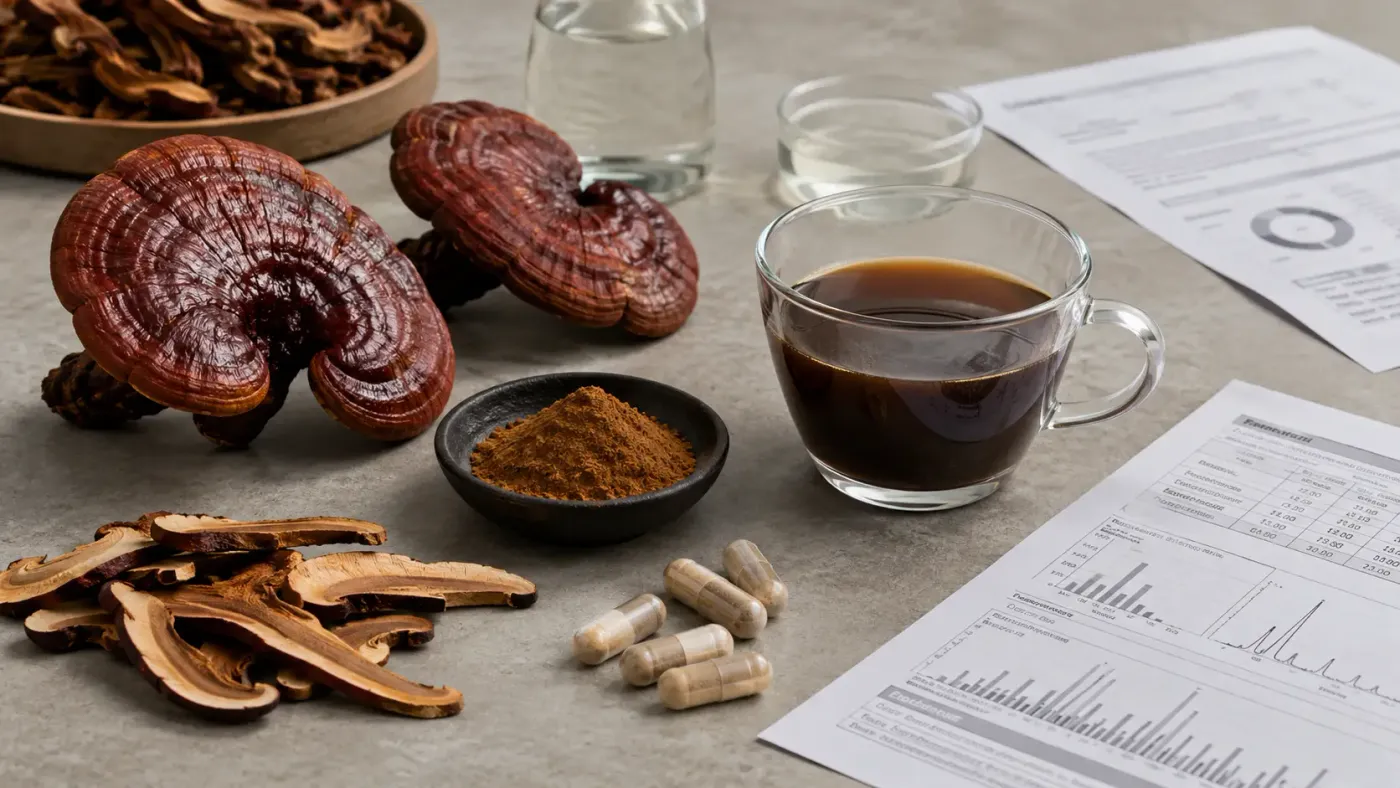
Before Reishi became a capsule, a dual extract, a spore powder, a softgel, or a number on a certificate of analysis, it was a hard fungus growing out of wood.
It is worth pausing on that image, because it explains almost everything that came afterward. Picture someone finding this thing for the first time, woody, varnished on top, tough as a dried bracket, growing off a fallen log. It is reasonable to imagine that the first people who encountered it tried to bite it, found it hard and bitter, and spat it out. Maybe they threw it away. Maybe, later, someone dried it and kept it. Maybe someone broke it into pieces and dropped them into boiling water, and drank the dark, bitter liquid that came out. Maybe someone else left the pieces soaking in strong alcohol.
This is not a historical record. Nobody can reconstruct the first human encounter with Reishi, and I am not trying to. It is only a way to think about the problem. But the imagined scene points at something real and permanent about this material:
Reishi was never something we could simply eat like a vegetable. It was a material we had to prepare.
We cannot chew a piece of dried Reishi fruiting body and expect the body to do much with it. It is too hard, too fibrous, too locked up inside its own structure. To get anything out of it, a human being has to do something to it first: break it, heat it, soak it, concentrate it. And the moment we accept that, we have arrived at the central idea of this article: the method of preparation decides what we actually get.
The best-documented traditional logic is water decoction: cutting or breaking the material, boiling it in water, and drinking the liquid. [1,2] Alcohol-based herbal preparations also existed in broader herbal practice and make chemical sense for less water-friendly compounds. But the important point here is not to argue which method came first. The important point is that every preparation method selects a different part of Reishi chemistry.
Water boiling selects one part. Alcohol selects another. Grinding the whole thing into powder keeps everything but releases very little. Modern extraction does the same job as the old methods, only with more control and more ways to go wrong. So before we can read a Reishi label honestly, we have to understand which part of the material a given product has actually made available. And before we can even ask that, there is a more basic question that the market quietly skips over: which Reishi material are we holding in the first place?
Reishi is not one material system
This is the first thing that trips people up. When a product says “Reishi,” it may not be talking about the same physical material as the next product that also says “Reishi.” Before we get anywhere near chemistry, we have to separate the material systems, because they are not interchangeable.
A short naming note first: many labels and older studies use Ganoderma lucidum. East Asian cultivated Lingzhi/Reishi is taxonomically more complicated and is often discussed as Ganoderma sichuanense or Ganoderma lingzhi depending on the source. [3,4] In this article I use “Reishi” and “Lingzhi” in the market-facing sense, while keeping that taxonomic caution in mind.
With that aside, there are three material systems worth separating.
A. Fruiting body.
The fruiting body is the main reference material in this article. It is the hard, woody-textured reproductive structure that traditional Lingzhi/Reishi use is mostly built around. [1] When people picture “Reishi,” this is usually what they are picturing, and it is the material with the longest documented use behind it.
B. Spores.
Spores are the reproductive units produced by the fruiting body. They are not concentrated fruiting body tissue, and treating them as a stronger version of the same thing is a category error. Comparing spore powder to fruiting body is closer to comparing an egg with the hen that produced it than to comparing two grades of the same cut of meat. The spore world has its own sub-forms: spore powder, broken-wall spore powder (where the tough spore wall has been cracked open to make the contents more reachable), and spore oil, which is a narrow lipid fraction taken from the spore. I will not go deep here, because spores deserve their own article later in this series. The point for now is simply that they are a different material system, judged on different terms.
C. Mycelium.
Mycelium is the root-like growth network of the fungus, although fungi do not have true roots. It is the vegetative stage the organism grows before it ever forms a fruiting body. Commercially, it shows up through two very different production logics. Solid-state fermented mycelium is grown on a solid substrate such as grain. Submerged fermentation mycelium is grown in liquid culture.
The solid-state route is especially relevant in parts of the North American mushroom supplement market, where some products are based on solid-state fermented mycelium, residual substrate, and sometimes young fruiting body material dried and milled together rather than extracted. [5,6] This is not a scandal and it is not an accusation against any particular company. It is simply a product-form fact worth understanding. These powders are usually not fully soluble. They may still show beta-glucan, because mycelium and fruiting body cell-wall material both contribute to the test result, but that does not make the product equivalent to a soluble extract.
Submerged fermentation has a different logic. In other mushrooms, it can be used deliberately to target certain fermentation-derived compounds, for example erinacines from Lion’s Mane mycelium, or classic protein-bound polysaccharide materials such as PSP and PSK from Turkey Tail-related fermentation traditions. [5] The existence of those examples does not mean Reishi mycelium automatically carries the same chemistry as Reishi fruiting body. The useful question is never “does mycelium have active compounds?” The useful question is: which mycelium, grown how, on what medium, harvested at what stage, and tested for which markers?
Once these three systems are separated, the rest of the article can focus where most Reishi product judgment actually happens: on the fruiting body. So that is the material we open up next.
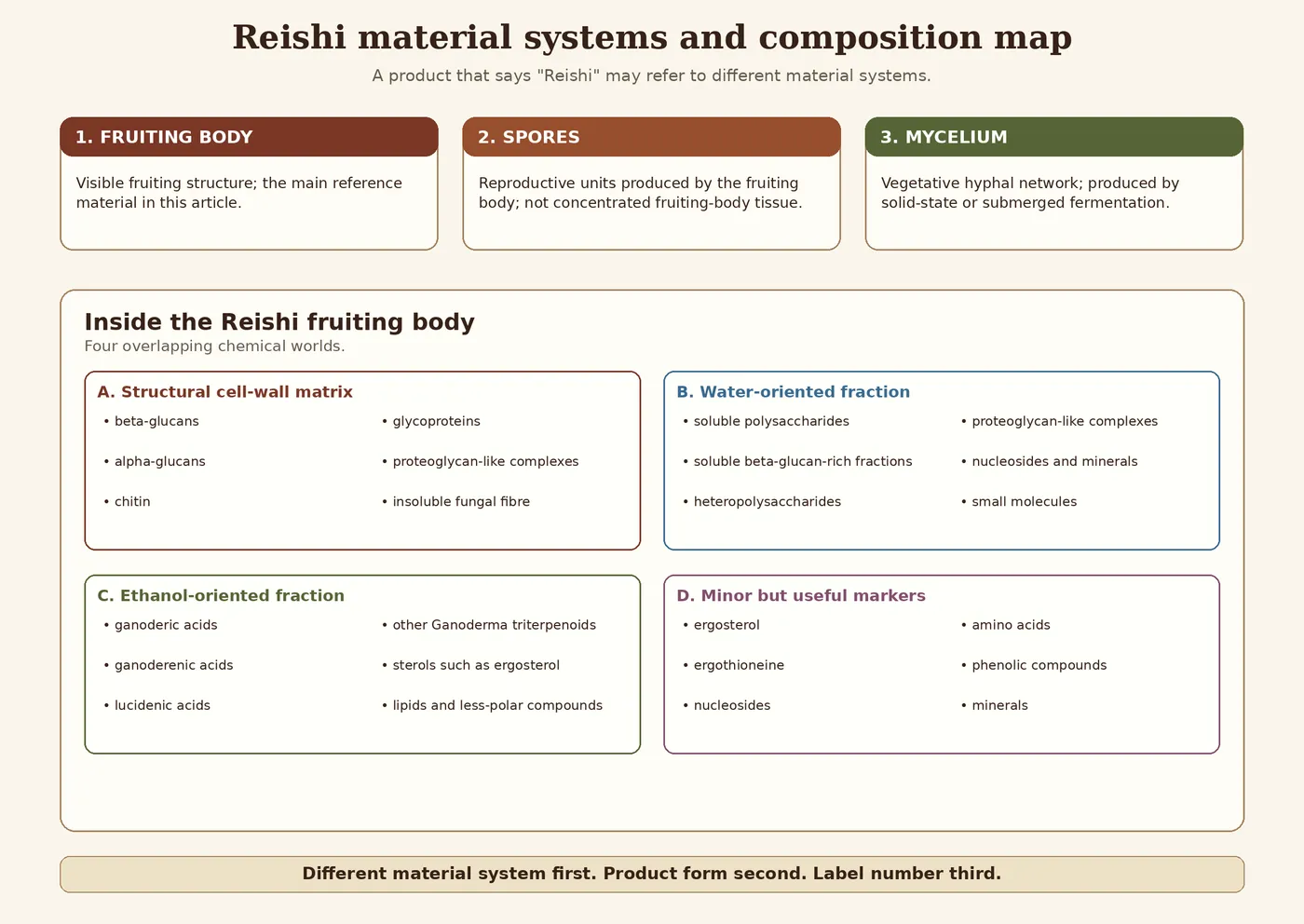
What is inside the Reishi fruiting body?
Let me use red cultivated Lingzhi fruiting body as the reference, because it is the form most people in the supplement world are actually buying and selling. It helps to stop thinking of a Reishi fruiting body as one substance and start thinking of it as several overlapping chemical worlds living in the same hard body. I find it useful to map it in four parts.
The structural cell-wall matrix
This is the scaffolding, the part that makes Reishi hard and woody to the touch. Reishi feels woody, but it is not plant wood. It is fungal tissue. Its structure is better understood through fungal cell-wall material (beta-glucans, alpha-glucans, chitin, glycoproteins, proteoglycan-like complexes, and insoluble fungal fibre) rather than through plant lignin. [7,8] This distinction matters because it changes how we reason about everything downstream: a fungal cell wall does not behave like a splinter of oak.
The water-oriented, water-extractable fraction
This is the part that water can reach. Soluble polysaccharides, soluble beta-glucan-rich fractions, heteropolysaccharides, glycoprotein and proteoglycan-like complexes, and some nucleosides, minerals and small molecules. [1,9] This is the side that a decoction pulls out, the side that a hot-water extract is built around, and the side most relevant to the prebiotic and gut-microbiota discussion that has grown up around mushrooms in recent years.
The ethanol-oriented, less-polar fraction
This is the part that water mostly leaves behind and that alcohol is much better at reaching. Ganoderic acids, ganoderenic acids, lucidenic acids and other Ganoderma triterpenoids, sterols such as ergosterol, and various lipids and less-polar compounds. [1,10] This is the side that alcohol extraction targets, and the side that HPLC or UPLC Reishi triterpenoid testing is actually measuring. One short method warning belongs here: a broad UV/colorimetric “total triterpenoid” number is not the same as HPLC/UPLC specific ganoderic acids or ganoderenic acids, especially when the UV method is calibrated against standards such as oleanolic acid or ursolic acid. [11,12] The label-reading article in this series works through that problem in full; here it is just a flag.
The minor but useful markers
Ergosterol, ergothioneine, nucleosides, amino acids, phenolic compounds, minerals. These are real and sometimes genuinely interesting, but they are supporting characters. They can help confirm identity or tell us something about the material, but they should not be turned into the headline quality standard for every Reishi product. A product is not good because it has ergosterol in it; ergosterol is just one signal among many.
Hold both layers in mind together, first the material system (fruiting body, spores, or mycelium), then, within the fruiting body, these four fractions, and almost every Reishi product on the market becomes easier to read. Each product is really a decision about which of these worlds to keep, release, or concentrate. There is one more distinction that sits underneath all of them, though, and it quietly drives a lot of the testing arguments in the industry.
Primary and secondary metabolites: two different kinds of chemistry
Biologists separate an organism’s chemistry into primary and secondary metabolites. [13] The simplest way I can put it:
Primary metabolites are what Reishi uses to build its body. Secondary metabolites show more of how Reishi lived.
Primary metabolites are the structural and metabolic basics: polysaccharides, beta-glucans, alpha-glucans, chitin, proteins, amino acids, lipids, nucleosides, minerals, and the cell-wall structure itself. Every Reishi has them, because no Reishi could exist without them. They are the bricks and mortar.
Secondary metabolites are the more characterful compounds: ganoderic acids, ganoderenic acids, lucidenic acids, the wider Ganoderma triterpenoid family, and certain phenolics, pigments and stress-related compounds. [1,10,13] The organism does not strictly need these to stay alive in the way it needs its cell walls, but it produces them in response to its genetics and its circumstances.
The pattern is easier to see across species than within one. A few examples make it concrete:
- Ginsenosides in ginseng, the compounds that give ginseng much of its chemical identity.
- Cordycepin in Cordyceps militaris, a marker closely associated with that species.
- Hericenones and hericenes in Lion’s Mane fruiting body, and erinacines in Lion’s Mane mycelium. Notice that even within one organism, the fruiting body and the mycelium express different secondary metabolites. That alone should make anyone cautious about treating mycelium and fruiting body as interchangeable. (This same fruiting-body-versus-mycelium question shapes how I read a Lion’s Mane product too.)
- Betulin and betulinic-acid-related compounds associated with Chaga, but with an important caution: in Chaga these are tied to its relationship with birch substrate biology, not produced by the fungus in isolation, so they should not be presented as simple Chaga-only metabolites.
There is also a market reason this matters. Secondary-metabolite language sells. A product that mentions triterpenoids, ganoderic acids, cordycepin, hericenones, erinacines or other marker compounds often sounds more advanced than a product that only says “mushroom powder.” That creates an incentive to use secondary-metabolite language even when the product form does not clearly support it.
And here is the nuance I do not want to lose: saying secondary metabolites are more “characterful” is not the same as saying primary metabolites do not matter. Beta-glucans, fungal fibres and soluble polysaccharides may be genuinely valuable, and the polysaccharide side of Reishi is the subject of a great deal of legitimate interest. So I am not ranking one above the other in importance to the body.
But for identifying and judging a product, the secondary metabolites usually carry more information, because they are more sensitive. The triterpenoid profile of a Reishi material shifts with many variables: strain; substrate, such as wood log versus sawdust substrate; cultivation method, such as indoor versus outdoor cultivation; geography; maturity at harvest, including whether the material was taken before or after spore release; season and rainfall; environmental stress; and post-harvest processing. [1,13] That sensitivity is exactly what makes secondary metabolites useful as fingerprints, and it is also why two products that both say “Reishi extract” can be chemically quite different.
The way I would say it:
Primary metabolites are necessary for the organism to grow and build itself. Secondary metabolites are often where the organism expresses its chemical individuality.
Both belong to a complete picture of Reishi. But they answer different questions, and a lot of label confusion comes from using one to make claims that really belong to the other.
Existing in the material is not the same as being available
That last point, that a Reishi material’s chemistry is real but uneven, leads straight into the idea that does the most work in this whole article.
A compound can exist inside Reishi and still not be available to the body.
This sounds obvious when written down, but a great deal of the supplement market quietly depends on people forgetting it. A lab can detect a compound in a sample. A label can print a number. Neither fact guarantees that the compound is in a form a human being can actually absorb and use.
A simple example is Reishi fruiting body fine powder. In my own testing experience, Reishi fine powder can show a high Megazyme beta-glucan result, sometimes above 40%. The beta-glucan is real, it is part of the fungal cell-wall structure, and the assay is detecting something genuinely present. [7,8,14] But much of it may be insoluble cell-wall material. The instrument can measure it after strong chemical and enzymatic treatment, and that is not the same as the human digestive system receiving it the way it would receive a soluble, beta-glucan-rich hot-water extract. In other words, a high number does not automatically mean high availability.
So the line to hold onto is short:
Detected is not the same as made available.
There is also an economic side to this, and it is worth being blunt about because it drives real product decisions. In my sourcing and production experience, Reishi fruiting body fine powder may cost only a small fraction of a true extracted material, sometimes in the range of USD 10-20/kg, while a properly extracted Reishi ingredient may cost tens, hundreds, or, for high-triterpenoid alcohol extracts, even several hundred dollars per kilogram. The exact number changes by market and specification, and these are my own production and sourcing benchmarks rather than universal global prices. But the economic incentive is obvious: if fine powder can raise a beta-glucan number, it can make a product look stronger at a much lower cost.
Hold both lines together, detected is not made available, and the cheaper material can raise the headline number, and the rest of the map starts to read differently:
- Some compounds are only released after long boiling, because they are bound up in a way that heat and time slowly open.
- Some are recovered far better by ethanol than by water, because they are less polar and water simply cannot reach them efficiently.
- Some stay locked inside insoluble fungal cell-wall material no matter how the material is brewed, and pass through largely untouched.
- And some can be measured by a laboratory method while still not being present in a form the body can easily use. The instrument sees the molecule, but the digestive tract does not get the same access the instrument did.
This is why “what is in the raw material” and “what the product makes available” are two different questions, and why the preparation method sits right in the middle of them.
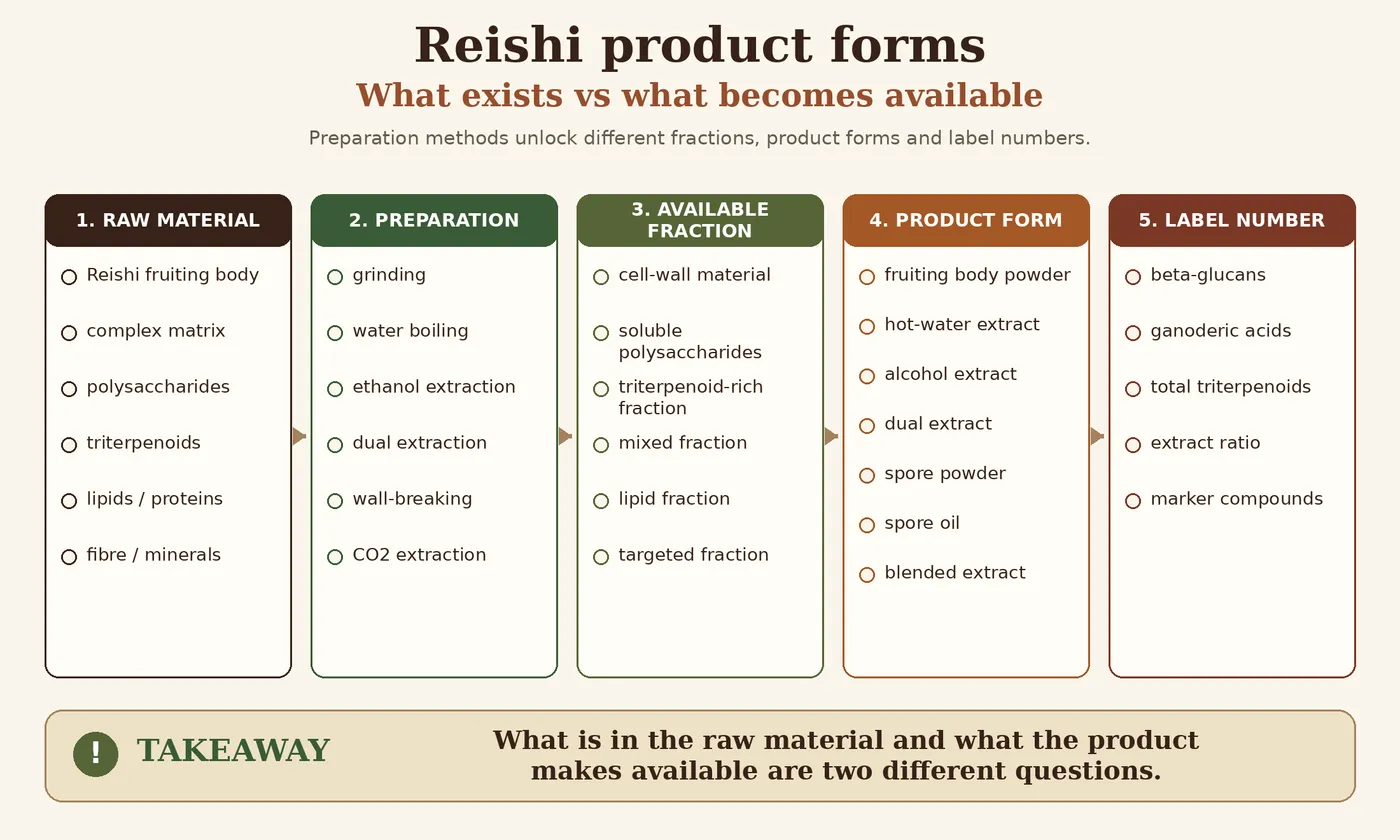
The method decides how much of the raw material’s chemistry actually crosses over into something usable. A product form is, in the end, a frozen decision about that crossing, which is exactly why the rest of this article is about reading the form.
The prebiotic side of Reishi
Before we get to the forms themselves, two words deserve a closer look, because they ride on this chemistry constantly: “prebiotic” and “adaptogen.” Both are useful. Both are also easy to use loosely.
“Prebiotic” is not one compound, and it does not belong to all forms of Reishi equally. For Reishi, the prebiotic idea lives mainly on the polysaccharide and cell-wall side of the fruiting body, the structural and water-oriented fractions. [9,15] That includes soluble polysaccharides, beta-glucans, heteropolysaccharides, glycoprotein-like complexes, and insoluble fungal fibres such as chitin-containing cell-wall material. These are the kinds of carbohydrates that may interact with the gut and its microbial community rather than being digested and absorbed like a simple sugar.
This distinction also matters in pet products, where “prebiotic mushroom fibre” is becoming a useful but sometimes loosely used idea. For that market, the form of the polysaccharide and cell-wall fraction matters as much as the word “prebiotic.”
Notice how unevenly the prebiotic idea maps onto product forms:
- Fruiting body powder contains cell-wall fibre, but much of it stays insoluble. The fibre is genuinely there; whether it behaves usefully depends on how much of it the gut can actually engage rather than just pass.
- Hot-water extract is the form most relevant to the soluble polysaccharide-rich fractions, because water extraction is built precisely to recover that side.
- Alcohol extract is aimed at the triterpenoid side, not the prebiotic fibre side. Asking an alcohol extract to be a prebiotic Reishi product is asking it to do a job it was not designed for.
- Dual extract may contain both a water-extracted polysaccharide side and an alcohol-extracted triterpenoid side, but its prebiotic relevance still depends on how much water-extracted or cell-wall carbohydrate fraction is actually present, and whether that fraction is disclosed.
- Spore powder may contain its own cell-wall material and carbohydrate fractions, especially before and after wall-breaking, but it should not simply borrow the prebiotic logic of a fruiting body hot-water extract. It is a different material system and needs to be judged separately.
- Spore oil is a lipid fraction. It is not a prebiotic Reishi product in any meaningful sense, and it should not be sold or understood as one.
So “Reishi is a prebiotic” is, at best, a half-sentence. The honest version is “the polysaccharide-rich preparations of Reishi are where the prebiotic discussion actually lives, and not every Reishi form carries that fraction.”
“Adaptogen”: a useful word that is often overused
Let me say plainly that I am not against the word adaptogen. I am against using it without saying what is behind it.
Adaptogen is a human-use concept, not a single class of compounds. It describes how a product is expected to help the body respond to stress or stay in balance. [16] That is a statement about an intended effect, not a statement about a specific molecule. There is no single “adaptogen compound” to point to on a chromatogram.
What makes the adaptogen idea chemically interesting in plants and fungi is usually a mix of compounds, and in many cases the most distinctive of those compounds are secondary metabolites, the ones shaped by genetics, substrate, maturity, environmental stress and ecological interaction. In other words, the interesting chemistry behind the word tends to sit on the same sensitive, individual side of the organism we talked about earlier.
This matters especially in lifestyle products such as mushroom coffee, mushroom gummies, chocolate blends and drink powders. Many of them use the word “adaptogen” on the front of the pack, but the actual mushroom dose may be small, the product form may be unclear, and no secondary-metabolite marker is shown. In that situation, “adaptogen” becomes a mood word rather than a product description.
For Reishi specifically, this creates an honesty problem worth naming. A hot-water extract that is rich in polysaccharides and beta-glucans may be a genuinely valuable product. It may speak to the polysaccharide, immune and gut-microbiota side of Reishi in ways that matter. But if that same extract contains very little of the triterpenoid side, the ganoderic acids, ganoderenic acids and related secondary metabolites, then it should be described for what it is: a polysaccharide-rich Reishi extract. It should not automatically be dressed up as a complete, full-spectrum adaptogen just because “adaptogen” sounds more impressive than “polysaccharide-rich.”
If a Reishi product is marketed as an adaptogenic or full-spectrum Reishi product, it should explain which part of the secondary-metabolite side supports that language, ideally with specific markers such as ganoderic acids or ganoderenic acids. Otherwise the word is doing more marketing work than technical work.
Two sentences I would stand behind:
A Reishi product can be polysaccharide-rich without being chemically complete as an adaptogen-style Reishi product. The problem is not the word “adaptogen” itself; it is using the word without explaining which part of Reishi chemistry the product actually contains.
Product forms are built directly from this chemistry
Now both layers of the map pay off. Every common Reishi product form is really a decision about which material system to use, and which part of its chemistry to keep, release, or concentrate. Here they are, each one gets fuller treatment later in this series.
Fruiting body slices and granules
The closest thing to traditional decoction or tea-like use. Not concentrated. What we actually get depends on heat, time, particle size and how the material is prepared, the same variables the old methods depended on. This is Reishi asking us to do part of the work.
Fruiting body powder
Keeps the whole material, including the insoluble cell-wall beta-glucan and fungal fibre. The appeal is that nothing is thrown away. The catch is that whole is not the same as available: grinding makes the material easier to swallow; it does not unlock everything inside it. As noted earlier, fine powder can show a high Megazyme beta-glucan value, and if it is added back into an extract the final beta-glucan number can rise even though much of that glucan is insoluble cell-wall material. This is one reason fruiting body fine powder can be economically attractive in products marketed around beta-glucan numbers: the number may look better than the actual availability.
Hot-water extract
Speaks mainly to the water-oriented polysaccharide side. More relevant to soluble polysaccharides and beta-glucan-rich fractions. A well-made one concentrates that side of Reishi; it is not where we should expect a strong triterpenoid number. A hot-water extract can also be changed by formulation choices: carriers, fine powder, or certain glucose-based fibres may change the final carbohydrate and beta-glucan profile. That deserves its own article, but the short rule is simple: a beta-glucan number without product-form disclosure is not enough.
Alcohol extract
Speaks mainly to the secondary triterpenoid side. More relevant to ganoderic acids, ganoderenic acids and related less-polar compounds. In simple terms, alcohol extract is strong where hot-water extract is usually weak: it is better suited to Reishi triterpenoids. But it is usually weak where hot-water extract is strong: it should not normally be expected to carry a high soluble beta-glucan fraction. The cost structure is also very different from fruiting body powder. In high-strength Reishi alcohol extraction, especially when the target is a high ganoderic/ganoderenic acid specification, yields are low: in my production experience, 1 kg of powder extract may require roughly 40-60 kg of raw material, and the finished ingredient can cost several hundred dollars per kilogram. (Again, those are my own production benchmarks, not universal prices.) This is also the form where fat-soluble pesticide and PAH-related residue concentration becomes more important, because ethanol does not only enrich the compounds we want, it can enrich unwanted lipophilic residues from the raw material at the same time.
Dual extract
A dual extract tries to combine the water and alcohol extraction logics so that both sides are represented. This is a reasonable idea, but it is worth understanding how dual extracts are actually made. In practice, they are often sold like a menu of specifications: 10% beta-glucan + 4% triterpenoids, 20% + 6%, 30% + 2%, and so on. The water-extracted powder and the alcohol-extracted powder may be produced separately, then blended in different ratios to match a target number and price point. That is commercially understandable, but it is a different philosophy from trying to preserve the full extractable profile of one batch of Reishi. I think of this as numbers-driven production.
In my own production and use experience, the most meaningful dual extract is not always the one with the most attractive numbers. The one that has felt most convincing to me is made by combining all the water-extracted fraction and all the alcohol-extracted fraction from the same batch of Reishi, rather than adjusting the blend only to hit a prettier specification. That is my manufacturing philosophy and personal experience, not a clinical claim, but it shapes how I judge dual extracts. The practical takeaways are simple: a dual extract is not automatically better; a disclosed dual extract is better than a vague one; and process, ratio, testing, same-batch logic, and formulation disclosure all matter more than the phrase “dual extract” on its own.
Spore powder, broken-wall spore powder, and spore oil
These belong to the spore material system, not the fruiting body, and they are not simply “stronger Reishi.” Spore powder is the whole spore. Broken-wall spore powder has had the tough spore wall cracked open so the contents are easier to reach, which also exposes them to oxidation and storage problems: the benefit and the risk arrive together. Spore oil is a narrow lipid fraction taken from the spore, usually by supercritical CO₂ extraction; it is one slice of the spore, not the whole meaning of Reishi. [17] None of these should borrow fruiting-body evidence as if it were its own.
“1:1 extract” and powder-like extracts
“1:1 extract” is one of the most confusing descriptions on the market. In a strict extraction logic, extraction means selecting and concentrating part of the raw material while removing part of what is not wanted, so there is normally a “more raw material becomes less final extract” relationship. When a product is called a 1:1 extract, then, the first question is simple: what was actually extracted, what was removed, and why is the ratio still 1:1? [18,19] If a so-called 1:1 extract was only boiled and dried without meaningful concentration, it may be closer to a cooked powder equivalent than to what most buyers imagine when they hear the word “extract”, and since ordinary fruiting body powder is normally heat-treated or steam-sterilised in production anyway, “cooked” alone is not enough to make a material a meaningful extract. None of this makes 1:1 extract automatically bad. It simply is not a strong quality claim on its own, and it needs explanation.
Blended and carrier-containing extracts
These may include carriers, fine powder, maltodextrin, polydextrose, resistant dextrin or other materials. [20,21,22] The existence of a processing aid is not automatically a scandal: drying real mushroom extract is genuinely difficult, and carriers sometimes start life as honest technical solutions. The real questions are whether they are disclosed, and whether they change the meaning of the test results. A carrier that quietly changes a beta-glucan, polysaccharide, alpha-glucan or triterpenoid number is a different thing from a disclosed processing aid that simply helps a powder flow.
Read that list with the two-layer map in mind and a pattern jumps out: no single form captures all of Reishi at once. Each one is a trade-off. That is not a flaw in the products. It is the nature of the material.
A simple guide to matching Reishi product form with product purpose
This is not a ranking, and there is no “best” row. It is a way to match what someone is actually looking for with the form most relevant to it, and, just as importantly, with what to check before trusting that form. (This is the practical side of a bigger idea I wrote about separately: choosing the right product, not the best product.)
| If you are looking for… | More relevant form | What to check |
|---|---|---|
| Traditional decoction logic | Slices, granules, or a hot-water-style extract | Preparation method; water extraction; soluble polysaccharide logic |
| The polysaccharide / beta-glucan side | Hot-water extract | Megazyme beta-glucan; solubility; carrier disclosure; whether fine powder was added back |
| The triterpenoid / ganoderic acid side | Alcohol extract or a disclosed dual extract | HPLC/UPLC ganoderic + ganoderenic acids, not only UV total triterpenoids |
| A whole-material philosophy | Fruiting body powder | Particle size; dosage; beta-glucan form; do not confuse powder with extract |
| A fuller Reishi profile | A well-disclosed dual extract | Water fraction; alcohol fraction; same-batch vs numbers-driven blend; both marker groups |
| Spore products | Broken-wall spore powder or spore oil, by purpose | Oxidation; storage; HPLC markers; do not borrow fruiting-body evidence |
| Lifestyle products | Coffee, gummies, chocolates, drink powders | Actual mushroom dose; product form; extract amount; marker testing; adaptogen wording |
| Cheap or vague “extract” products | Often a powder-like or 1:1 extract, or carrier-containing material | Whether it is truly extracted; carrier disclosure; solubility; test method; COA detail |
Practical takeaway
This series is not here to tell anyone which form to buy. It is here to make us better readers. So before we even get to a Reishi label, here is the set of questions worth asking, and notice that every one of them is really a question about which part of the chemistry we are dealing with:
- Which material system is it: fruiting body, spores, or mycelium?
- Is it powder, hot-water extract, alcohol extract or dual extract?
- Which side of Reishi chemistry does it represent: the polysaccharide side, the triterpenoid side, or both?
- If a product says “dual extract,” does it explain whether it is truly dual extracted, or only a blend of a water extract and an alcohol extract, and is it same-batch or numbers-driven?
- If a product says “1:1 extract,” what was actually extracted and what was removed?
- If beta-glucans are high, are they soluble and extracted, or mainly from fine powder and cell-wall material?
- A simple home check: does the powder dissolve well in water, or does a large insoluble fraction remain? This is not a lab test, but it can hint at whether the product behaves more like a soluble extract or more like fine powder.
- If the product only says “triterpenes” or “triterpenoids,” is the method UV/colorimetric, or specific HPLC/UPLC ganoderic acids?
- If the word “adaptogen” is used, does the product show any secondary-metabolite marker, such as ganoderic acids or ganoderenic acids? If not, the word may be more marketing than technical description.
- Are carriers, fine powders, maltodextrin, polydextrose, resistant dextrin, or other excipients disclosed?
None of these questions, on its own, decides whether a product is good. Together they tell us what kind of product we are actually holding.
And that is the real conclusion. There is no product form that is always best. A fruiting body powder, a hot-water extract, an alcohol extract and a well-disclosed dual extract are not competitors in a single race; they are different answers to different needs, built from different parts of the same organism. What matters is understanding the form first.
Product form is the first layer of product judgment. The label, the certificate of analysis and the specifications are the layers that come after it. If we try to read the numbers before we understand the form, the numbers can be made to say almost anything. If we understand the form first, the numbers finally have to tell us the truth.
That is exactly where this series goes next, in Reading a Reishi Label Is Not the Same as Understanding the Product.
Author-experience notes
The following points in this article are presented as manufacturing, sourcing, testing, or use experience from the author. They are not presented as universal market prices, fixed manufacturing standards, or literature-derived facts:
- Reishi fine powder may cost roughly USD 10-20/kg in the author’s sourcing experience.
- Properly extracted Reishi ingredients may cost tens, hundreds, or several hundred USD/kg depending on the specification.
- High-strength Reishi alcohol extract may require roughly 40-60 kg raw material for 1 kg powder extract in the author’s production experience.
- Reishi fine powder can show high Megazyme beta-glucan values, sometimes above 40%, in the author’s testing experience.
- The author’s preference for same-batch full-fraction dual extract over numbers-driven specification blending is a manufacturing philosophy and personal-use judgment, not a clinical claim.
- Fat-soluble pesticide and PAH-related residue concentration in high-strength alcohol extracts is presented as a repeated manufacturing concern from the author’s production experience and extraction logic.
Claims kept deliberately cautious
- Polydextrose and resistant dextrin are discussed as glucose-based fibres that may change carbohydrate and beta-glucan interpretation. This article does not claim that they are always counted as beta-glucan by Megazyme without product-specific laboratory evidence.
- North American solid-state mycelium / mycelium-on-substrate products are discussed as a product-form category, not as an attack on any brand.
- “Adaptogen” is discussed as a product-description honesty issue, not as a medical claim.
- “1:1 extract” is discussed as an interpretation problem. The article does not say all 1:1 extracts are fraudulent.
Related reading on Yi Loves Mushrooms
- Reading a Reishi Label Is Not the Same as Understanding the Product, the companion article on reading Reishi labels and COAs (beta-glucans, ganoderic acids, triterpenoid methods, pesticide panels). This Product Forms article is the layer that comes before label reading; the label article is the natural next step, and it is where the UV-vs-HPLC triterpenoid problem flagged here is worked through in full.
- How to Think About Mushroom Products: Not the Best Product, but the Right Product, the opening philosophy article for Yi Loves Mushrooms, which sets up the “right product, not best product” framing used throughout this series.
- Lion’s Mane for Mood, Cognition and Healthy Ageing, a worked example of the same fruiting-body-versus-mycelium and marker-compound thinking applied to another mushroom.
- Future Part 2 of this series (Reishi raw materials, cultivation variables, and the real supply chain), link once published.
- Future Reishi extraction article (hot-water vs alcohol vs dual extract, including numbers-driven vs same-batch dual extracts, yields and residue concentration), link once published.
- Future Reishi spore powder and spore oil article, link once published.
- Future article on Reishi and mushroom mycelium (solid-state vs submerged fermentation, mycelium-on-substrate product forms), link once published.
References / Further Reading
- Wachtel-Galor S, Yuen J, Buswell JA, Benzie IFF. “Ganoderma lucidum (Lingzhi or Reishi): A Medicinal Mushroom.” In Herbal Medicine: Biomolecular and Clinical Aspects, 2nd ed. NCBI Bookshelf, 2011. View source
Show all 22 references
- Health Canada. Mushrooms, Natural Health Product Monograph. Updated October 25, 2024. View source
- Wang XC, Xi RJ, Li Y, Wang DM, Yao YJ. “The Species Identity of the Widely Cultivated Ganoderma, ‘G. lucidum’ (Ling-zhi), in China.” PLOS ONE. 2012. View source
- Du Z, et al. “Re-Examination of the Holotype of Ganoderma sichuanense and a Clarification of the Identity of Chinese Cultivated Lingzhi.” Journal of Fungi. 2023. View source
- Berger RG, et al. “Mycelium vs. Fruiting Bodies of Edible Fungi, A Comparison of Metabolites.” Journal of Fungi. 2022. View source
- Megazyme / Nammex. Redefining Medicinal Mushrooms: A new scientific screening program for active compounds. View source
- Gow NAR, Latgé JP, Munro CA. “The Fungal Cell Wall: Structure, Biosynthesis, and Function.” Microbiology Spectrum. 2017. View source
- Ruiz-Herrera J, Ortiz-Castellanos L. “Cell Wall Glucans of Fungi. A Review.” The Cell Surface. 2019. View source
- Zhong Y, et al. “A Review of Ganoderma lucidum Polysaccharide: Preparations, Structures, Physicochemical Properties and Application.” Foods. 2024. View source
- Guo WL, et al. “Ganoderic Acids-Rich Ethanol Extract from Ganoderma lucidum…” Pharmaceuticals. 2022. View source
- Lu J, et al. “Quality Difference Study of Six Varieties of Ganoderma lucidum with Different Origins.” Frontiers in Pharmacology. 2012. View source
- Chen DH, et al. “The Triterpenoid High-Performance Liquid Chromatographic Fingerprint… Ganoderma lucidum.” Methods and Protocols. 2023. View source
- Keller NP. “Fungal Secondary Metabolism: Regulation, Function and Drug Discovery.” Nature Reviews Microbiology. 2019. View source
- Megazyme. β-Glucan Assay Kit (Yeast and Mushroom), K-YBGL. View source
- Mirończuk-Chodakowska I, Witkowska AM, Zujko ME. “Beta-Glucans from Fungi: Biological and Health-Promoting Potential.” Nutrients. 2021. View source
- European Medicines Agency. Reflection Paper on the Adaptogenic Concept. EMA/HMPC/102655/2007. View source
- Liu J, et al. “Bioactive Components, Pharmacological Properties and Underlying Mechanisms of Ganoderma lucidum Spore Oil.” 2024. View source
- Monagas M, et al. “Understanding Plant to Extract Ratios in Botanical Extracts.” 2022. View source
- European Medicines Agency. Guideline on Quality of Herbal Medicinal Products / Traditional Herbal Medicinal Products. EMA/HMPC/CHMP/CVMP/201116/2005 Rev. 3. 2022. View source
- FDA. Review of the Scientific Evidence on the Physiological Effects of Certain Non-Digestible Carbohydrates. View source
- Do Carmo MMR, et al. “Polydextrose: Physiological Function, and Effects on Health.” Nutrients. 2016. View source
- Hofman DL, van Buul VJ, Brouns FJPH. “Nutrition, Health, and Regulatory Aspects of Digestible Maltodextrins.” Critical Reviews in Food Science and Nutrition. 2015. View source