What is really in a Lion’s Mane extract
Two powders can both be sold as Lion’s Mane extract and still contain very different things. One may be mostly drying carrier. Another may combine extracted material with ground mushroom. A third may be a selected, fully water-soluble fraction. A mycelium extract made for erinacine A is another product again.
In this article 14 sections
- Where the glucans are and where they go
- First make the mushroom soup
- Why getting a powder can change the recipe
- A laboratory number needs a method and a matrix
- The residue makes the point very clearly
- Separation gave us a different water extract
- The biggest cost difference may be the yield
- An ethanol extract has a different purpose
- Freeze-drying cannot erase the earlier heat
- Liquid cultivation produces mycelial biomass
- What our biomass results do and do not show
- A 1% biomass powder is possible without making an extract
- How 0.1% can become 2% without creating more
- What I would ask before buying
The name on the bag is a starting point. To understand the product, we need to follow the material: what went in, what was removed, what was added, and what the test actually measured. Even information from a supplier needs evidence behind it.
I want to explain these differences through production I have worked on. The purpose is to help readers ask better questions, whether they are buying a capsule or developing an ingredient. There is no single best Lion’s Mane product for every purpose.
Three questions to keep in mind
Does a high beta-glucan number mean a fully soluble extract? No. Ground mushroom and spent extraction residue can also give high numbers.
Does 100% mushroom-derived mean 100% extract? No. Ground fruiting body added to an extract is still mushroom-derived.
Does a higher marker percentage mean more was produced? No. Removing other material can raise a percentage even while some of the marker is lost.
How to read the evidence: production observations and in-house results below describe my own materials and conditions. Numbered references support the external science or analytical principles. The cost and erinacine calculations are identified as examples. None of these manufacturing observations establishes a health benefit.
Where the glucans are and where they go
A Lion’s Mane fruiting body is built from tightly arranged fungal threads called hyphae. Its hanging teeth and inner tissue are both made from these structures. Beta-glucans are important components of the cell-wall matrix around fungal cells; they are not confined to one visible part of the mushroom.
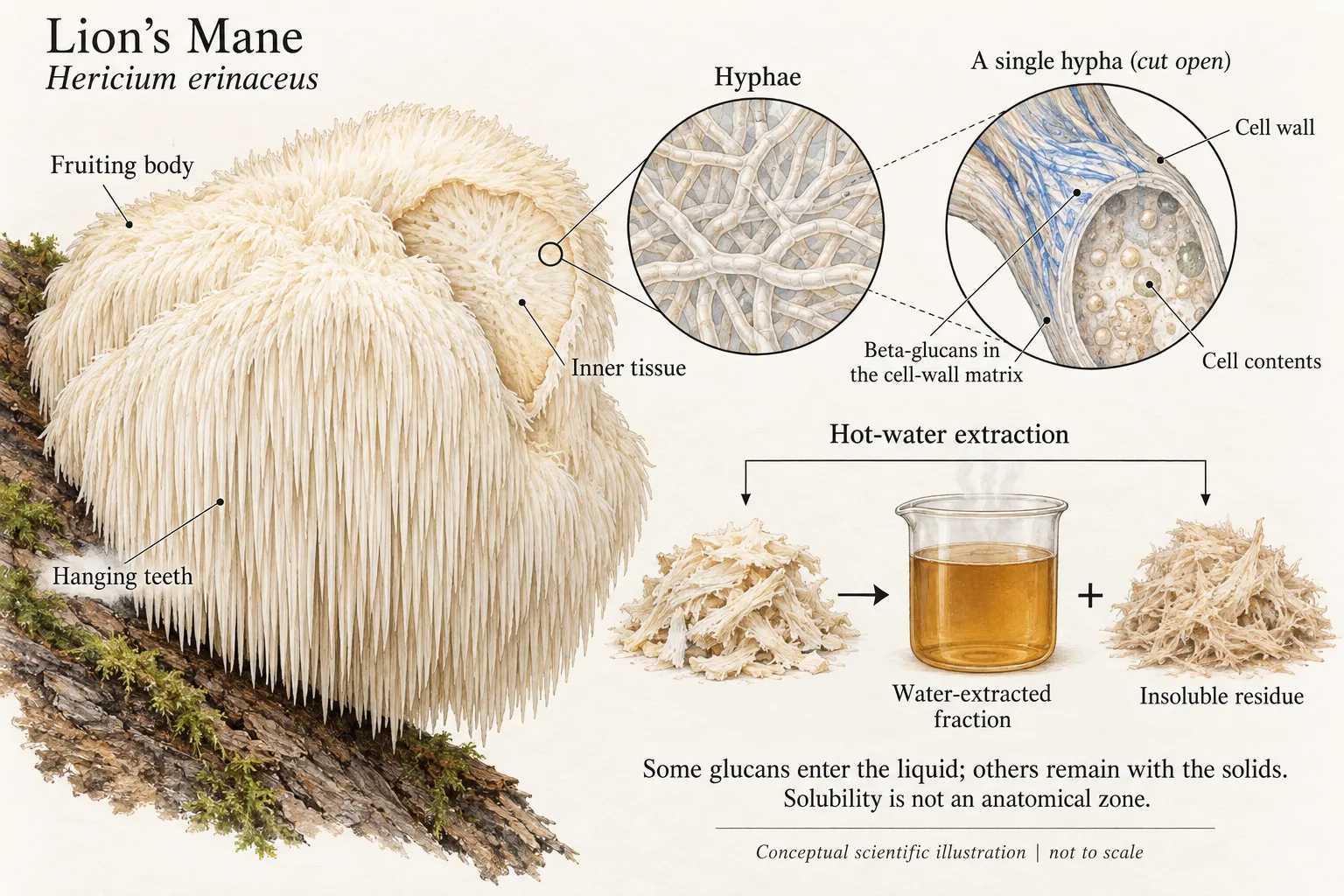
Plate A. Whole fruiting body, a conceptual hyphal detail and the two destinations after water extraction. The molecular network is schematic, not a measured map of this species or batch.
The useful distinction is what happens during extraction. Some glucan-containing material enters the liquid; some remains associated with the insoluble material. The split depends on the material and the process. It is misleading to color one part of the intact mushroom soluble and another part insoluble.
A general cell-wall principle is illustrated here, not a universal layer-by-layer model. Solid-state NMR research on another mushroom-forming fungus, Schizophyllum commune, identified chitin and beta-glucan in its rigid wall structure. That supports the conceptual wall inset, but does not establish an anatomical solubility map for Lion’s Mane. [7]
Read the arrows as processing pathways, not a before-and-after molecular measurement. Water-soluble behavior does not mean every glucan is extracted, and a high beta-glucan assay result does not establish water solubility.
First make the mushroom soup
Start with 100 kg of dried Lion’s Mane fruiting bodies, the familiar mushroom part of Hericium erinaceus. In this production case, the material was hot-air dried, with moisture below 11%, and cut or broken into pieces. It was not yet powder or extract.
The first water-extraction step is easier to understand than its name suggests: cook the mushroom pieces in water, rather like making mushroom soup. We extracted twice at 90-95°C, first for two hours and then for another 1.5 hours. We separated liquid from the mushroom pieces, combined the liquids and used plate-and-frame filtration to remove further insoluble material.
- 100 kgDried fruiting body
- Hot water90-95°Ctwo stages
- 35 kgExtracted solidsFilter + concentrate
The 35 kg is still in liquid at about 15-20% solids
Figure 1. Observed production route. Solid-equivalent weights describe material in the liquid, not bags of finished powder.
Next, a double-effect vacuum concentrator removed much of the water. Think of reducing a soup or making juice concentrate: the liquid becomes richer because there is less water around the dissolved material. The concentrate was typically around 15-20% solids. At 15%, 100 kg of concentrate contains about 15 kg of dry material and 85 kg of water.
From 100 kg of starting material, this process recovered about 35 kg of water-extracted solids. Those solids were still dissolved in liquid. At 15% solids, 35 kg would sit in roughly 233 kg of concentrate; at 20%, roughly 175 kg. These are illustrative calculations, before further losses.
The 35 kg is a recovery from the raw-material input. It is neither a 35% concentrate nor 35 kg of ready-to-sell powder. It also does not prove that 35% is an intrinsic water-soluble fraction under every possible extraction condition. The difficult step was turning this particular liquid into a usable powder.
Why getting a powder can change the recipe
In our equipment, the unmodified water concentrate was sticky. During spray drying, material adhered to the tower walls. What we could collect was difficult to handle and prone to moisture uptake and caking. A powder that looks acceptable at packing can later become lumps, interrupt capsule filling or harden in its container.
Changing to vacuum drying or freeze-drying did not, by itself, solve the handling and storage problem for this concentrate. Removing water and obtaining a stable, free-flowing powder are different achievements.
My working explanation is that small sugars, oligosaccharides and other moisture-sensitive soluble components contribute to this behavior. We have not measured the separate contribution of each group. Food-drying research offers a useful explanation: temperature, moisture and composition can make an amorphous powder turn soft and sticky. This is related to its glass transition. Research on a maltodextrin-sucrose model supports that general principle; it does not identify the composition of our mushroom concentrate. [1]
What a drying carrier does
A suitable carrier changes the mixture being dried. Maltodextrin can raise the glass transition temperature of a sugar-rich mixture and reduce stickiness under appropriate conditions. Think of sticky fruit concentrate being incorporated into a more manageable dry matrix. The carrier remains in the product; it is not a processing tool that disappears afterward.
Carriers are common across the extract industry. Depending on the application, formulators may consider maltodextrin, gum arabic, modified starches or dextrins, including resistant dextrin. They are not interchangeable. Their drying behavior, taste, solubility and analytical response need checking in the actual formula.
| In the example recipe | Calculation | Dry-basis share |
|---|---|---|
| Water-extracted mushroom solids | 35 kg | 40% |
| Added carrier | 35 × 1.5 = 52.5 kg | 60% |
| Theoretical finished material | 35 + 52.5 = 87.5 kg | 100% |
This is a recipe I know from production, not a universal ratio. A carrier can serve a legitimate purpose. The problem is selling a 40% extract-solids and 60% carrier mixture without making that composition clear. Using a carrier and hiding a carrier are different decisions.
A laboratory number needs a method and a matrix
Polysaccharides and beta-glucans are not interchangeable label claims. The phenol-sulfuric acid method responds broadly to carbohydrates; it does not identify their mushroom origin. Maltodextrin is a carbohydrate and contributes to that response. Calling the result mushroom polysaccharides can therefore mislead when the formula contains added carbohydrate. [2]
In a maltodextrin-containing product I have encountered, the reported polysaccharide result could exceed 60%, while beta-glucan was around 0-5%. The attractive first number did not tell the reader how much mushroom-derived beta-glucan was present.
Polydextrose raises a different issue. In my comparisons using Megazyme K-YBGL, its addition markedly increased the reported beta-glucan result, with results above 40%. I would not describe that increase as additional mushroom beta-glucan. This is an observation from our tests, not a conclusion that every polydextrose grade or every procedure gives the same response.
- Total glucanMeasured
- Alpha-glucanMeasured
- Beta-glucanCalculated difference
Figure 2. K-YBGL uses a difference calculation. It is an analytical measurement, not a certificate of ingredient origin. [3]
K-YBGL determines total glucan and alpha-glucan through specified chemical and enzymatic procedures, then calculates beta-glucan by subtraction. The result must be interpreted with the sample composition and procedure. Megazyme announced a further method update effective 1 October 2025, so the kit name alone does not identify the exact protocol. Ask which revision, sample preparation and reporting basis were used. [3]
To investigate an unexpected result, I would want the carrier tested alone, suitable controls and a spiked mushroom matrix, with recovery and repeatability checks. Knowing the kit name is valuable, but it does not replace those checks. A high number alone proves neither purity nor adulteration.
Practical interpretation: ask for the complete formula and the actual batch report. Then ask whether the method is suitable for that formula. Do not try to reconstruct the whole ingredient from one percentage.
The residue makes the point very clearly
One of my records includes the material left after extraction. It had a high beta-glucan reading even though, in my water observations, it remained insoluble. That is not a contradiction. A laboratory procedure can break down and measure material that does not dissolve in a glass of water.
| Material in the supplied record | Alpha reading | Beta reading |
|---|---|---|
| Lion’s Mane extract batch 1 | 5.3 | 41.24 |
| Lion’s Mane extract batch 2 | 4.92 | 22.17 |
| Lion’s Mane extract batch 3 | 4.6 | 25.3 |
| Lion’s Mane extract batch 4 | 13.22 | 28.55 |
| Lion’s Mane extract batch 5 | 5.15 | 28.21 |
| Lion’s Mane spent extraction residue | 1.14 | 52.92 |
Table 1. Transcribed from my supplied results screenshot; I identified the kit as K-YBGL. Values are reproduced as displayed. The cropped image does not show units, moisture basis, protocol revision, replicates or uncertainty, so no unit has been added here. The five extract rows have not been matched to the five membrane-production batches or to particular recipes. An unrelated species row is omitted.
Can mushroom powder replace another carrier
Yes. Another route I have used combines equal dry weights of water-extracted solids and fine powder made from the same mushroom fruiting body: 35 kg plus 35 kg, giving about 70 kg before losses. The fine powder is 80 mesh or finer. It provides physical support and useful density for capsule filling.
In materials we tested, the fine powder could contain over 25% beta-glucan and under 5% alpha-glucan; the finished blend could exceed 30% beta-glucan. Some of the final result comes from unextracted mushroom powder. The percentage does not tell us how much of the beta-glucan is water-soluble.
This blend is mushroom-derived throughout, but it is not entirely extract and it does not fully dissolve. Fine particles can remain suspended or settle. That may be acceptable in a capsule and unsuitable in a drink intended to have no sediment. Microbial control also matters: we have used steam treatment around 95°C for 45 minutes, but a heat step alone does not establish sterility.
Separation gave us a different water extract
We also made a carrier-free powder by changing the separation process. This was production across five batches, rather than a single laboratory trial. Starting with the same approximate 35 kg of water-extracted solids per 100 kg of dried fruiting body, ceramic-membrane processing yielded a selected fraction equivalent to about 7 kg of powder that we could spray dry without adding carrier.
- 35 kgWater-extracted solids
- 7 kg selectedCarrier-free powder
- 3.5 kg precipitateFurther processing70% premixed solution
- 35 kgWater-extracted solids
- 28 kg other solidsNot in target powder
Figure 3. Approximate dry-material pathway per 100 kg starting mushroom. The 3.5 kg powder is a further-processed portion of the 7 kg, not an additional co-product.
The remaining approximately 28 kg of extracted solids still presented drying difficulties under our conditions. They had not vanished. They simply were not part of the selected powder.
In testing, the membrane powder generally showed about 25-40% beta-glucan and around 5% alpha-glucan. The screenshot on the previous page is a separate record and is not evidence that every membrane batch falls in that range. In my water observations, this powder dissolved completely without obvious fine-powder residue. At 4 g in 100 mL water, it was noticeably thick. The glucan assay measured the whole powder; the water observation is a separate finding.
I do not know the membrane specification or molecular-weight cutoff. Successful drying cannot tell us that missing number. Composition, moisture, operating conditions and interactions among components all affect drying. A membrane specification and analysis of both separated streams would be needed to explain the separation more precisely.
Further ethanol precipitation
We treated the selected material with a pre-prepared 70% ethanol solution at room temperature for about four hours, then separated and dried the precipitate. Batch yield records show approximately 3.5 kg of dry precipitate from the 7 kg portion. The 70% describes the solution added, not a confirmed final ethanol concentration after mixing.
This powder tested above 56% beta-glucan and below 3% alpha-glucan. At 2 g in 100 mL water it dissolved in my observation and appeared even thicker than the membrane powder at 4 g. These are simple preparation observations, not matched instrumental viscosity tests. Precipitation changes composition; it neither measures molecular weight nor proves greater clinical effectiveness.
The biggest cost difference may be the yield
A small difference in processing cost can become a large difference in cost per kilogram when the amount of saleable powder changes sharply. To show this without publishing raw-material or fine-powder purchase costs, let X be the raw-mushroom cost in USD/kg, Y the basic processing cost per kg of mushroom input, Y₁ the membrane-route processing cost and Y₂ the membrane-plus-precipitation processing cost.
For this illustration, use a 500 kg input and scale the preceding approximate yields. Let M and P be maltodextrin and polydextrose costs in USD/kg, and F the prepared fine-powder cost. The formulas exclude other costs. In the manufacturing scenario I am describing, the added separation fees were modest relative to the yield effect; that relationship need not hold at another plant.
| Route | Powder output | Illustrative batch cost in USD |
|---|---|---|
| Maltodextrin carrier blend | 437.5 kg | 500X + 500Y + 262.5M |
| Polydextrose carrier blend | 437.5 kg | 500X + 500Y + 262.5P |
| Equal-weight fruiting body powder blend | 350 kg | 500X + 500Y + 175F |
| Membrane fraction | 35 kg | 500X + 500Y₁ |
| Membrane then precipitation | 17.5 kg | 500X + 500Y₂ |
Table 2. Divide each batch-cost expression by its output to obtain the modeled cost per kg. All outputs are idealized dry-material equivalents; scaling assumes the same recoveries. The precipitation output is a scaled scenario based on the recorded 7-to-3.5 kg step, not an independently documented 500 kg production run.
For scale only, the carrier input prices in this example are CNY 5/kg for maltodextrin and CNY 10/kg for polydextrose. If r is the chosen number of CNY per USD, then M = 5/r and P = 10/r. This preserves the disclosed input prices without presenting an undated exchange rate as current.
The carrier blend produces 12.5 times the mass of the membrane powder, and 25 times the mass of the precipitation powder. Those are output ratios, not exact cost or value ratios. The smaller selected fractions can cost much more per kilogram even when their added processing fees are not dramatically higher.
This simplified model gives no credit for the remaining streams and excludes residual moisture, actual handling losses, packaging, transport, storage, finance, overhead and tax. Cost allocation changes if other streams can be sold. A selling-price illustration at 40% gross margin would divide the modeled cost by 0.60; that is an assumption, not an industry rule or quotation. Neither low nor high price establishes product quality.
An ethanol extract has a different purpose
So far, the discussion has centered on water extraction. But a fruiting body also contains secondary metabolites such as hericenones and hericenes. These are different chemical targets from beta-glucans, so a process designed around them should be judged differently.
In one process I worked on, dried fruiting body was extracted once with 80% v/v ethanol for two hours at 70°C. The liquid was concentrated while recovering ethanol. We then added approximately an equal dry weight of fruiting body fine powder and freeze-dried the mixture. The resulting design was about 50% ethanol-extracted solids and 50% fine powder.
Why add so much mushroom powder here too? Because the concentrated ethanol extract could not be dried into a usable product directly under our conditions. The fine powder helped us obtain a manageable dry material. It was part of the formulation, not evidence of additional extraction.
It is reasonable to suspect that the solvent selects a different mixture from hot water, including compounds with different polarity, while much cell-wall material remains behind. But we did not analyze this concentrate for its sugar profile, ester composition or drying properties. I cannot identify the substances responsible for its drying difficulty, or claim that all of them were small molecules.
The product does not fully dissolve in water. It includes insoluble fine powder, and its ethanol-extracted fraction should not be assumed to behave like a water extract. However, saying the entire blend is completely insoluble would go beyond what its recipe establishes: different components may dissolve, disperse or settle to different degrees.
The specifications used for this product include over 2% combined hericenones and hericenes and over 20% beta-glucan. The beta-glucan result comes mainly from the fine powder added back; this ethanol route was not designed to maximize beta-glucan recovery. A combined marker specification also needs a defined list of compounds, standards and analytical method. It does not describe a universal category.
The practical question changes with the target: for a beta-glucan ingredient, ask about the glucan-containing fraction; for a secondary-metabolite ingredient, ask which compounds were quantified and how much survived each processing stage. Neither specification substitutes for the other.
Freeze-drying cannot erase the earlier heat
In my own heat tests, some hericenone-related components degraded under test conditions above 50°C. This is a process observation. It does not establish a single decomposition threshold for every hericenone and hericene, in every solvent or product.
The 70°C ethanol extraction described on the previous page is therefore a real question, not a detail to leave out. What happens during those two hours, concentration and solvent recovery? Without matched, stage-by-stage measurements, I cannot say how much of each marker was preserved. The extraction temperature and the separate heat tests cannot be reconciled by simply calling the product freeze-dried.
| Drying method | What happens | What the name does not establish |
|---|---|---|
| Spray drying | Liquid is atomized into droplets in hot air; water evaporates rapidly. | The inlet-air temperature is not the same as the material temperature. |
| Vacuum drying | Reduced pressure helps remove solvent; material temperature and time still matter. | Vacuum does not mean no heat exposure. |
| Freeze-drying | Frozen water is removed mainly by sublimation under vacuum, followed by further drying. | Freezing and the later drying stages do not make the whole process heat-free. |
Choosing freeze-drying may reduce additional thermal stress during the final drying stage. But it does not recover compounds already lost during extraction, concentration or storage. Nor does it prove that the finished powder will remain unchanged in hot coffee.
The useful evidence would follow the same batch from raw material through extract, concentrate and finished powder. We would need the mass at each stage as well as the marker concentration, along with actual product temperatures and holding times. A higher final percentage can otherwise hide a lower total recovery.
The same logic applies to mycelium extracts. I would not assume that erinacine A behaves like a hericenone, or that every erinacine must be freeze-dried. A compound, solvent, matrix and temperature-time history need to be evaluated together.
A drying label describes one manufacturing step. It does not replace a retention study or demonstrate that a commercial ingredient reproduces an effect reported in research.
Liquid cultivation produces mycelial biomass
The mushroom fruiting body is only one form of Lion’s Mane. Its mycelium is a growing network of fungal threads. In liquid cultivation, a selected strain grows in a nutrient medium. The fungal material we harvest is called mycelial biomass.
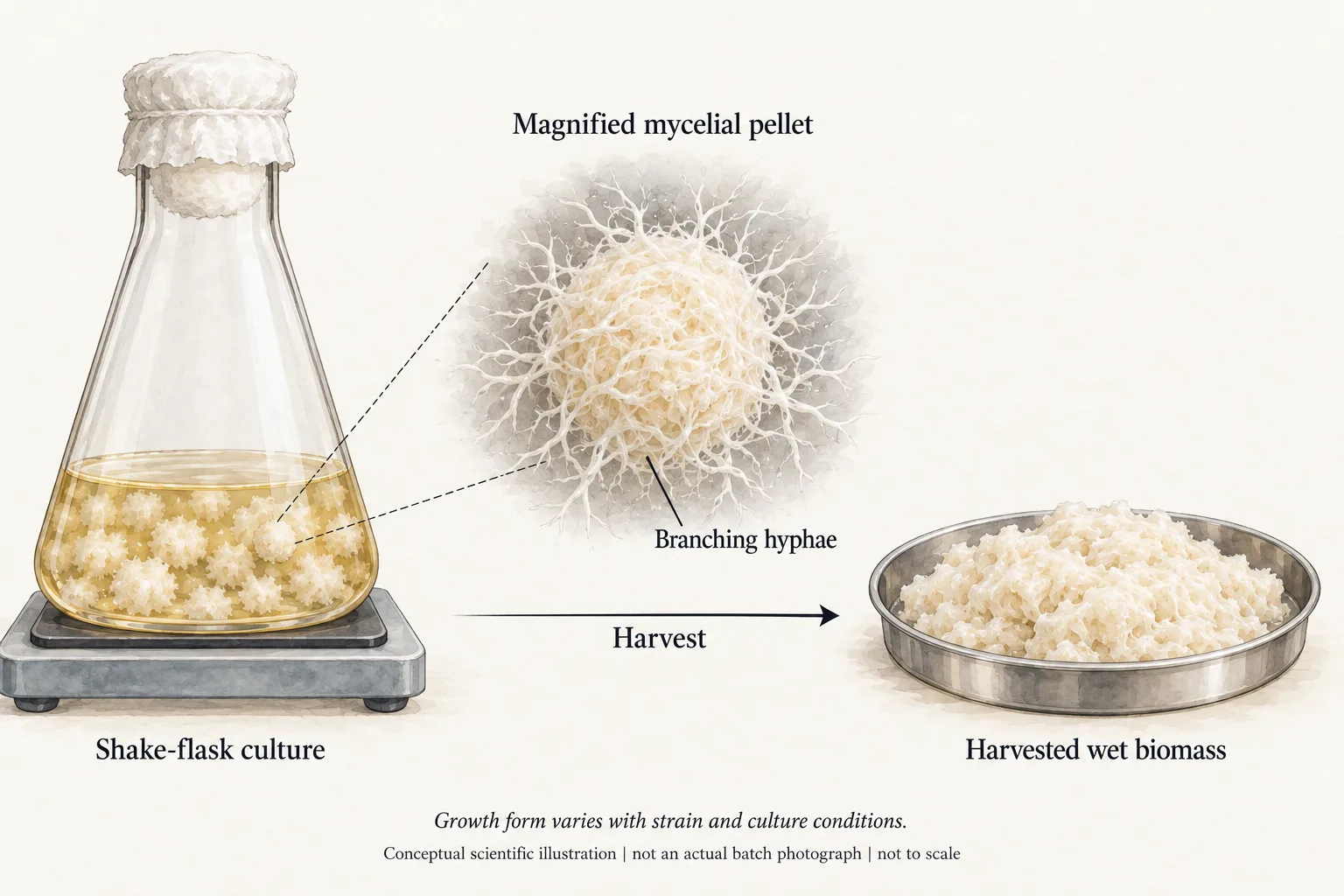
Plate B. Laboratory shake-flask culture, a conceptual pellet enlargement and harvested wet biomass. This is a teaching illustration, not an image of my own batch or an industrial fermentation vessel.
The culture may contain small pellets, looser clumps or more dispersed hyphae. Their size and form depend on the strain and culture conditions. The magnified view explains how a pellet is made from branching threads; its appearance alone cannot identify the species or tell us its erinacine A content. [6]
Here I am following the harvested biomass. It can be dried and milled as a whole-mycelium powder, or processed further to make an extract. Those are different ingredient routes. A fine powder is not automatically an extract, and a high erinacine A percentage does not automatically mean extraction was used.
The wet biomass and the finished dry powder are different states of the material. Any percentage comparison below concerns dry biomass or finished dry extract, not the water-heavy freshly harvested material.
What our biomass results do and do not show
| Material | How it is made | What the name leaves unanswered |
|---|---|---|
| Myceliated grain | Mycelium and remaining grain substrate are dried and milled together. | How much of the powder is remaining substrate? |
| Harvested liquid-grown biomass powder | Mycelium is harvested, dried and milled, without a separate extraction step. | What was the dry-biomass composition and marker content? |
| Mycelium extract powder | Harvested biomass is extracted; the selected fraction is concentrated and dried. | What were the extraction yield and marker recovery? |
In our development work, we isolated strains from cultivated Lion’s Mane material and investigated liquid cultivation. Carbon and nitrogen sources, aeration, temperature, pH and harvest timing all form part of the process. Growing a large amount of fungus and producing biomass rich in a particular secondary metabolite are related but separate goals.
Our dry-biomass erinacine A results have ranged from about 0.01% to 0.1%, or 0.1-1 mg per gram. The variation occurred even under nominally similar culture conditions. This is what we have achieved in our own work so far. It is not a biological ceiling for Lion’s Mane mycelium.
Under some of our current conditions, higher production was observed around days 14-18. A 2010 study found its highest erinacine A production at eight days in its optimized system. Those results are compatible: different strains and processes can have different harvest windows. [4]
A 2015 erinacine C cultivation study and a 2025 comparison of Hericium strains also show why one recipe should not be treated as optimal for every target. Conditions that promote growth need not promote the same metabolite profile. An erinacine A process should not simply borrow an erinacine C optimum. [5,6]
To understand a process, I want both the marker concentration in dry biomass and the amount of dry biomass harvested. I also want repeat-batch results and a comparable assay. A concentration alone does not tell us the total marker output, process stability or production cost.
A 1% biomass powder is possible without making an extract
It would be a mistake to conclude that direct-dried mycelium cannot reach 1% erinacine A just because our present biomass is lower. Public commercial descriptions include liquid-grown mycelium that is harvested, freeze-dried and milled, with a stated 1% erinacine A specification. This is a supplier-described whole-biomass ingredient, rather than a solvent-extract powder. [8]
| Material and evidence | Erinacine A | How to interpret it |
|---|---|---|
| Commercial freeze-dried biomass powder; published supplier specification [8] | 1% = 10 mg/g | A stated specification for the dried biomass ingredient; not a result measured by me. |
| Our current dry mycelial biomass; in-house observations | 0.01-0.1% = 0.1-1 mg/g | The concentration in our biomass before further extraction. |
| Our research extract powders; in-house development batches | 1.11% and 1.99% = 11.1 and 19.9 mg/g | Concentration after extraction and concentration; not our original biomass content. |
Table 3. These values refer to different materials and evidence sources. The commercial statement is not independent batch verification. A direct comparison requires compatible assays, reference standards and dry-mass reporting bases.
On comparable dry-mass and analytical bases, 1% is approximately 10-100 times our present 0.01-0.1% biomass concentration. That is a concentration ratio, not a measured ratio of total fermentation output or manufacturing efficiency. We do not yet know which combination of strain, cultivation, harvest or analytical factors explains the difference.
- Harvested biomassSame starting material
- Dry and millFreeze-drying is one option
- Mycelial biomass powderNo solvent extraction
- Harvested biomassSame starting material
- Extract and concentrateThen dry the selected fraction
- Mycelium extract powderA selected, concentrated fraction
Figure 4. Two ingredient routes from harvested mycelial biomass. Drying and milling alone do not make a solvent extract.
Freeze-drying removes water and can affect retention of existing compounds. It does not synthesize erinacine A. Once materials are compared on a dry basis, the large concentration difference cannot be explained merely by saying that one powder was freeze-dried. Nor does this commercial example establish that freeze-drying is required for every erinacine A process.
How 0.1% can become 2% without creating more
With our lower-content biomass, we explored a different route: ethanol extraction, concentration and vacuum drying, not freeze-drying. No carrier was added in that development route. Different research batches gave in-house erinacine A results of 1.11% and 1.99%. These are extract results, not evidence that our fermentation itself produced biomass at those percentages.
- 100 kg dry mycelium0.1% = 100 g erinacine A
- 4 kg final extract80 g / 4,000 g = 2%80% target recovery | 4% extract mass yield
20 g lost: a higher percentage, less total erinacine A
Figure 5. Hypothetical mass balance, not our measured batch yield. A higher percentage can coexist with less total target compound.
Imagine 100 kg of dry biomass containing 0.1% erinacine A. It contains 100 g of the compound. If extraction retains 80%, we recover 80 g. If the final extract weighs 4 kg, then 80 g divided by 4,000 g is 2%. Twenty grams have been lost, even though the final percentage is twenty times higher.
The relationship is: final concentration = starting concentration × marker recovery ÷ extract mass yield, with the two yields expressed as fractions on a consistent dry basis. Here, 0.1% × 0.80 ÷ 0.04 = 2%. Extraction has removed much of the surrounding material; it has not created more erinacine A.
In our own before-and-after single-analyte tests, erinacine A showed relative stability through the extraction conditions used. The time-temperature history and a complete mass-recovery assessment would still be needed for a stronger retention claim. I would not apply our separate hericenone heat observations to all erinacines, or say erinacine A always requires freeze-drying.
A 1.99% research sample does not establish stable commercial production at 10, 50 or 100 kg. It also does not make our extract equivalent to direct-dried 1% biomass. At the same stated percentage, two materials can still have different surrounding composition, processing histories and research relevance.
Ask two questions separately: how much erinacine A did the cultivation produce in the biomass, and how much of that existing compound did the extraction retain in the final powder?
What I would ask before buying
A certificate of analysis is useful, but it cannot always reconstruct the product. Information can be lost as an ingredient moves through a manufacturer, trader, formulator and finished-product brand. The brand may not realize how much of the original process is missing from its documents.
| Ask about | A useful answer should identify |
|---|---|
| Raw material | Species, fruiting body or mycelium; substrate included or separated. |
| Process | Direct milling, water or ethanol extraction, membrane separation, precipitation and drying. |
| Complete composition | Every carrier and powder added back, with its proportion. |
| Test result | Actual batch, method and revision, reporting basis, defined markers and suitable standards. |
| Intended use | Dose, dissolution, sediment, viscosity, flavor, capsule filling and stability. |
| Traceability | Records connecting the recipe, process and tested sample to the supplied batch. |
For a capsule, a clearly disclosed extract-and-fruiting-body-powder blend may be a reasonable choice. For a beverage, sediment and viscosity can matter as much as the headline percentage. The fully soluble membrane powder in my example still thickened water, so full solubility alone did not make it suitable for every drink.
For an ingredient developed around hericenones, hericenes or erinacine A, I would focus on the actual compounds, analytical reliability, processing recovery and stability. I would also ask whether the material and dose resemble those used in any research cited. A laboratory mechanism, animal study or cultivation paper does not establish an effect in people taking a different commercial powder.
The judgment I want readers to build
I do not want to rank these routes as a simple ladder from cheap to superior. They make different materials. A disclosed carrier, a mushroom-powder blend and a selected soluble fraction can each have a purpose. What matters is whether the description is honest, the evidence supports the claims and the product fits its intended use.
When I see Lion’s Mane extract on a label, my next question is: which material, made how, tested how, and for what purpose? A supplier who can answer with connected records gives us much more to work with than a supplier who offers only a large number.
References and evidence boundaries
8 sources · tap to open
The production cases and in-house results are my own observations. They are separate from the published sources below. Approximate production weights are not complete analytical mass balances. The cost formulas and the 0.1%-to-2% example are teaching calculations.
[1] Truong V, Bhandari BR, Howes T. Optimization of co-current spray drying process of sugar-rich foods. Part I. Journal of Food Engineering (2005). https://doi.org/10.1016/j.jfoodeng.2004.10.017 Model-system evidence for moisture, glass transition and stickiness; not a compositional analysis of Lion’s Mane.
[2] DuBois M et al. Colorimetric Method for Determination of Sugars and Related Substances. Analytical Chemistry 28 (1956), 350-356. https://doi.org/10.1021/ac60111a017 The carbohydrate assay principle; not a test of mushroom origin.
[3] Megazyme. K-YBGL Yeast and Mushroom Beta-Glucan assay documentation and FAQ. https://www.megazyme.com/beta-glucan-assay-kit-yeast-mushroom Official method source. The protocol revision actually used on a sample should be recorded.
[4] Krzyczkowski W et al. Erinacine A biosynthesis in submerged cultivation of Hericium erinaceum: Quantification and improved cultivation. Engineering in Life Sciences 10 (2010), 446-457. https://doi.org/10.1002/elsc.201000084 Cultivation and HPLC study; its eight-day optimum belongs to its tested conditions.
[5] Wolters N, Schembecker G, Merz J. Erinacine C: A novel approach to produce the secondary metabolite by submerged cultivation of Hericium erinaceus. Fungal Biology 119 (2015), 1334-1344. https://pubmed.ncbi.nlm.nih.gov/26615754/ Primary research on erinacine C cultivation, not a clinical trial or a universal recipe for erinacine A.
[6] Polysorbate 80 Differentially Impacts Erinacine Production Profiles in Submerged Cultures of Hericium. Molecules 30 (2025), 2823. https://doi.org/10.3390/molecules30132823 Strain, treatment and sampled fraction affect measured production profiles.
[7] Characterization of the cell wall of a mushroom forming fungus at atomic resolution using solid-state NMR spectroscopy (2020). https://pmc.ncbi.nlm.nih.gov/articles/PMC7649524/ Primary structural research on S. commune; used for general wall context, not species-specific localization of soluble fractions.
[8] Published supplier specification for liquid-grown, freeze-dried Lion’s Mane mycelium with 1% erinacine A. Supplier specification and described manufacturing route A commercial first-party statement, not independent verification or a comparison with my own batches. Used only to document that a directly dried biomass ingredient is publicly described at 1%.
Official supplementary method link: Megazyme K-YBGL FAQ. Web references checked for availability on 17 October 2026. Publisher or repository pages may apply access controls; DOI links provide persistent identifiers.
The supplied cropped results image is a private production record, not an independent laboratory certificate. Its displayed readings are transcribed in the results table without adding units or claiming independent verification. Personal correspondence, factory names and customer identities are excluded.
More from Yi Loves Mushroom
-
 Lion’s Mane for mood, cognition and healthy ageing
 -
 Mushroom fruiting body vs mycelium: what is actually in the bag
 -
 How to Read Cordyceps Labels in Europe
 -
 Understanding Reishi product forms Is the first step before reading the label
 -
 Reading a reishi label is not the same as understanding the product
 - How to think about mushroom products: not the best product, but the right product